Does Chokeberry Bush Need a Pollinator to Fruit?
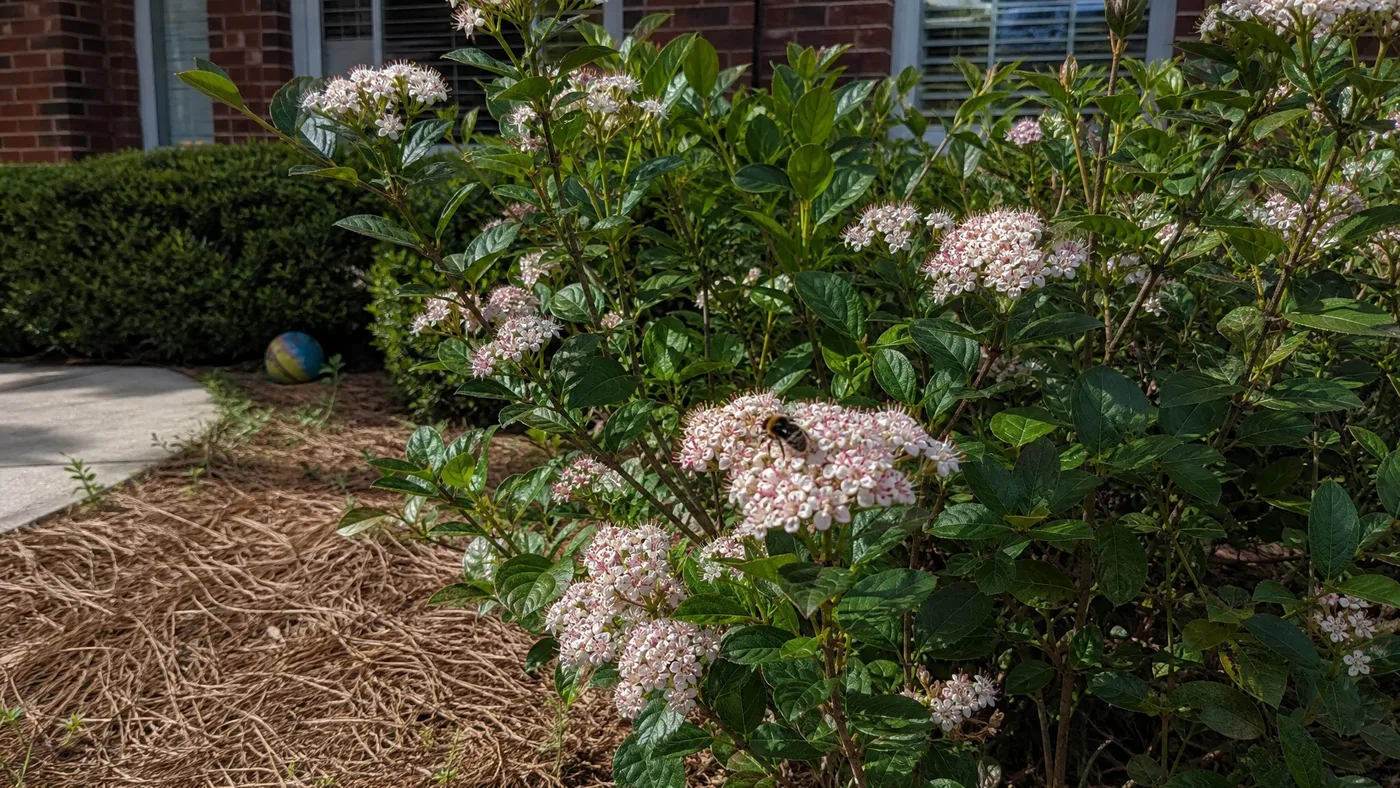
Crouch next to your red chokeberry on a May morning and look at a single flower. Five white to light pink petals, a ring of red anthers, and a center that holds the female parts too. Nothing in there is waiting on a separate male plant, and no secret handshake is required.
That one flower goes a long way toward answering the question people ask us before they buy: will a lone plant fruit? In our experience it does. Where it goes wrong is shade, a late frost, or a spray pass that clears out the bees, and none of those is fixed by buying a second bush.
Read on to see how the red chokeberry flower is built, what the research does and does not say about a single plant, how suckers turn it into a clump, which insects do the work, and how far apart to set two or three.
What a Chokeberry Bush Flower Actually Does
Start with the flower, because everything else in this guide follows from how it is built. Look at it closely and the pollination question mostly answers itself.
One Flower, Both Jobs
The flowers are white to light pink, about an inch across, with five petals and red anthers. Those anthers are the male parts. In the middle sits the female part that turns into a berry. The USDA Forest Service seed manual describes chokeberry blooms as white, bisexual flowers, which botanists also call perfect flowers.
This is the opposite of a holly or a kiwi, where one plant carries male flowers and another carries female ones. Chokeberry is not split that way, so you never have to sort males from females at the nursery.
What Happens in the Cluster
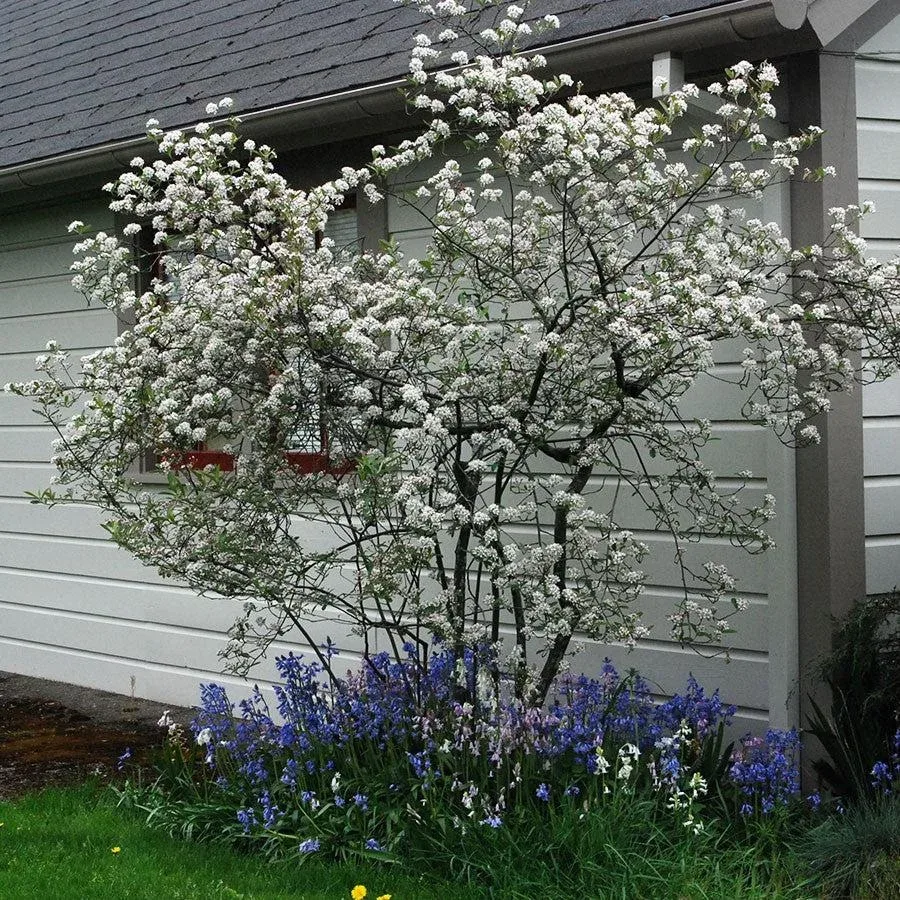
Flowers open in clusters along the branches in May. Each flower that is fertilized will swell into a glossy red berry, ripening from September to November and often hanging on through winter. We see a cluster open over several days rather than all at once, so the plant is offering pollen for a good stretch.
Timing shifts with latitude and elevation, so go by what your own plant does. Our bloom time guide covers the calendar in detail.
Why One Chokeberry Bush Usually Fruits on Its Own
Here is the plain answer to the title question, along with an honest note on how firm the evidence is.
A single red chokeberry sets fruit in gardens all the time. We often see lone 'Brilliantissima' plants loaded with berries in fall, and Oregon State credits the cultivar with more abundant glossy red fruit than the species. Because every flower carries both parts, there is no male plant to find. If you saw "dioecious" in a search result, that term does not apply to chokeberry.
The research is firmer for black chokeberry, the fruit crop sold as aronia. Iowa State Extension says aronia is self-fruitful and needs no pollinator for fruit set. Red chokeberry has not been studied as closely as a crop. The Forest Service manual says it produces good seed crops almost every year, but we have not found a study of a lone red plant, so we put it this way: one plant fruits, and a second can only help.
What a lone plant still needs is something to move the pollen. A flower will not always drop its own pollen onto its own center unaided, so an insect brushing across the cluster makes the difference. That is why the next sections cover the visitors, not the partner plant.
If a lone bush flowers well and then sets few berries, look at the site before blaming pollination. The best fruit and flower production occurs in full sun, and a bush in deep shade will bloom thinly and fruit lighter. Our sun requirements guide explains where the line falls.
How Chokeberry Bush Roots and Suckers Multiply
This is the part of the biology that surprises buyers most, and it changes how you think about "one plant" versus "two."
Red chokeberry spreads by suckering. New stems rise from the roots around the parent, and over a few seasons one plant becomes a clump of stems. NC State gives a mature width of 3 to 6 feet but adds that the shrub tends to sucker and form colonies, so a clump left alone will keep pushing past that footprint.
Why Suckers Do Not Count as a Second Plant
Suckers are the same plant. They share the parent's roots and carry the same genes. When a clump starts flowering, every stem is a genetic copy of the one you planted, so the clump behaves as one plant for pollen purposes. It is a bigger plant with more flowers, which helps yield, but it adds no new genetic variety.
What You Do About It
Decide early how much colony you want. Cut or dig suckers that stray outside your planting bed, and leave the ones inside. You can also lift a sucker with roots and move it, which is the cheapest way to get a second plant, even if it is a clone. Our guide to propagating by division or cuttings walks through the steps.
Bees Do the Work, so Let Them
A plant that fruits alone is not self-sufficient. Insects carry the pollen, and your job is to keep them coming back to the shrub.
The open, shallow flowers are easy pickings for bees and flies, and we see both working a bush in bloom. NC State Extension notes that butterflies and bees come to the flowers for nectar. You do not need to buy or manage anything. You need to avoid driving them off and to have flowers nearby that cover the weeks around chokeberry bloom.
Steps to Keep Pollinators Around
Follow these in the weeks before and during bloom.
- Do not spray anything on or near the bush while flowers are open. NC State lists no serious pest problems for red chokeberry, though leaf spot, twig and fruit blight and roundheaded apple tree borer can turn up, so there is rarely a reason to spray in bloom.
- Plant it in full sun. Bees work sunny, warm flowers first and shaded ones last.
- Put other spring bloomers within a few steps so insects have a reason to stay in the yard. Our companion plant ideas cover good neighbors.
- Leave a patch of bare soil or a brush pile nearby. Many native bees nest in the ground or in dead stems.
Cold, Wet Weather
The real threat to a single bush is a cold, rainy bloom week when few insects fly. A cluster may open and fade without being visited. Nothing you do fixes that on the day, which is one honest argument for more than one plant. Our wildlife guide covers who else shows up later, when birds and mammals come for the winter berries.
Why Two Plants Still Beat One
Having said one plant is enough, we still recommend two for anyone who wants a real harvest. The reasons are practical, not required.
More flowers in the yard means more stops for each passing bee, and two shrubs side by side make a bigger target than one. Customers usually ask us whether a second plant doubles the berries. Our answer is that it mostly adds flowers and a safety margin, a modest gain rather than a miracle.
Two Plants Give You Insurance
A second bush also covers you when one has a bad year. If one plant gets a frost-nipped bloom, is browsed by deer (red chokeberry has little resistance to them), or ends up in a shadier corner than you planned, the other keeps the berries coming.
Where Variety Comes From
Genetic variety only comes from a plant with different genes, and that rules out more than you might think. A sucker is a clone, even after you move it across the yard. A named cultivar like 'Brilliantissima' is kept true by propagating it vegetatively rather than from seed, so two of them are copies of the same plant too.
If you want a mixed planting, pair 'Brilliantissima' with a straight-species red chokeberry or a black chokeberry. Red and black chokeberries hybridize readily, which tells you insects do carry pollen between the two. Mixed sources are a small edge, but a real one.
Spacing a Chokeberry Bush Pair or Trio
If you go with more than one, the spacing decides whether you get two healthy plants or one crowded tangle.
Because chokeberry suckers, give each plant room to fill out. Red chokeberry reaches 3 to 6 feet wide, so space plants roughly that far apart for a loose, tidy row, toward the wider end if you want each one to stay distinct. For a denser hedge look, set them closer and accept that stems will merge. For local advice on your exact conditions, check with your extension service.
Layout Checklist
Run through this before you dig.
- Set all plants in the same sun exposure, so none lags behind in flower and fruit.
- Stagger a trio in a loose triangle rather than a straight line, so bees can move between all three in a short hop.
- Keep the pair close enough that pollinators treat them as one patch, not so close that suckers tangle.
- Leave a mowing strip or edging on the outer sides to catch suckers heading for the lawn.
Our planting guide covers hole size, depth and timing.
One Chokeberry Bush or Two: Your Call
You now have the facts, so here is how to decide without overthinking it.
Choose one if space is tight, if you mostly want the spring flowers and scarlet fall color, or if you plan to divide it later for a second plant. A lone red chokeberry will flower and fruit, and its fall color is the same either way. Nothing about the plant forces you to buy in pairs.
Choose two or three if berries are the goal and you have the room. You get more flowers per visit, a hedge against a poor bloom week, and a backup if one plant struggles. Raw berries are very astringent, though sweeter than black chokeberry, so size your planting to what you will cook into jams and jellies, and read our berry guide before you plant a whole row.
If you are unsure, plant one now and add a second next year from a sucker. It adds flowers rather than genetic variety, but it costs nothing and tests whether you want more.
Plant the Chokeberry Bush and Move On
The short version is that pollination is rarely the problem you think it is. Red chokeberry has bisexual flowers, a lone plant fruits in our experience, and bees and flies carry the pollen. Give it full sun, keep sprays off during bloom, and one plant will fruit.
Chokeberry Bush
Nursery-grown Chokeberry Bush in sizes from 2 GALLON, shipped to your door.
From $93.12
Shop Now →Plant one if you are short on room and two if you have it, then stop worrying about partners. We grow and ship our 'Brilliantissima' shrubs ourselves, and before a plant leaves us our growers check the roots, the stems and the overall vigor, so it is ready to flower and fruit.