Is Chokeberry Bush Native or Invasive in the US?
Twenty-seven states list red chokeberry, Aronia arbutifolia, as native, along with the District of Columbia and five Canadian provinces. That one number settles most of the argument before it starts. A shrub with a native range that wide is part of the landscape, not a visitor to it.
The question still comes up every spring, when new suckers push through the mulch around the base and people start to worry about a takeover. Get the answer wrong and you either skip a handsome shrub out of fear or plant it where you wanted one tidy clump. Get it right and you gain white spring flowers, glossy red fruit that birds visit and scarlet fall leaves.
We'll walk you through the native range by region, the wet and dry places where it grows wild, how it spreads by suckers and seed, and how our 'Brilliantissima' plants differ from wild ones, then give you our verdict.
Reading the Whole American Landscape
Three words get mixed up in this debate, and the answer depends on keeping them apart. We define them first, then place the shrub on the map.
Native means a plant grew in a region on its own and belongs to the local plant community. Introduced means people brought it in from somewhere else. Invasive means an introduced plant that spreads into natural areas fast enough to crowd out what lives there. Most introduced garden plants never leave the bed, so introduced does not mean invasive. Native does not promise good manners either, which is why we look at behavior separately.
On the first question, the sources agree. Red chokeberry is native to eastern North America. Oregon State's landscape plant database traces the native range from Massachusetts to Florida, reaching west as far as Minnesota, Arkansas and Texas.
Picture the eastern half of the country, from the Atlantic coast to the Texas and Oklahoma line. Within it, red chokeberry turns up in swamps, bogs and wet thickets, and in dry woodland thickets too. A shrub at home in that many settings does not need one special disturbed spot to get established. That is the first clue to its character.
Outside that range it is an introduced garden plant. We come back to what that means in the verdict.
Where Chokeberry Bush Grows Wild by Region
A state-by-state native list is the clearest count we have. This table groups that list by region.
| Region | Native states listed | Count |
|---|---|---|
| New England | Connecticut, Maine, Massachusetts, New Hampshire, Rhode Island | 5 |
| Mid-Atlantic | Delaware, Maryland, New Jersey, New York, Pennsylvania | 5, plus Washington, DC |
| Great Lakes and Ohio Valley | Kentucky, Michigan, Ohio, West Virginia | 4 |
| Southeast | Alabama, Florida, Georgia, Mississippi, North Carolina, South Carolina, Tennessee, Virginia | 8 |
| South Central and Plains | Arkansas, Kansas, Louisiana, Oklahoma, Texas | 5 |
That adds up to 27 native states. The same entry adds five Canadian provinces: New Brunswick, Nova Scotia, Ontario, Prince Edward Island and Quebec.
The Northeast and Mid-Atlantic Core
The northern part of the range runs along the coast and inland to the Great Lakes, and that is where many gardeners first meet the shrub.
Ten of the 27 states on the table sit in New England or the Mid-Atlantic, plus Washington, DC. Michigan and Ohio carry the range toward the Great Lakes. In Maryland alone, the University of Maryland Extension records the plant in the mountains, the Piedmont and the Coastal Plain.
The Southern and Western Edge
Farther south and west, the list runs well past the mountains and onto the Gulf Coast.
Florida, Louisiana, Mississippi and Texas are all on the list, and Kansas and Oklahoma mark the western edge. Lists differ a little at the margins. Oregon State includes Minnesota, while the state-by-state list we counted does not, so check your own state's records if you garden near an edge.
Our chokeberry growing zones guide covers cold and heat tolerance. This guide only asks where the plant belongs.
Inside a Single Chokeberry Bush Thicket
Zoom in from the map to one stand of wild shrubs. The University of Maryland Extension says red chokeberry is typically found in swamps, bogs, or dry woodland thickets, and the other sources describe it the same way, in both wet and dry thickets.
Wet Thickets and Bog Edges
The wet end of that list is where thickets form most readily.
The plant tolerates wet sites and occasional flooding, and it takes boggy soils. Its neighbors there are whatever else can stand wet feet, along swamp margins, pond edges and streambanks. The shrub shares that ground with them and does not need to push them out.
Dry Woodland Thickets
The dry end is just as real, and it shows how flexible the plant is.
In dry woodland thickets, red chokeberry grows with other shrubs at the edges of trees, in sun or part shade. The garden version of that range is wide: any soil texture including clay, dry, moist or wet, and acidic. It is drought tolerant once established, which is why we plant it well away from water too.
What the Thicket Looks and Smells Like
Walk a thicket in spring and you meet the shrub's sensory side.
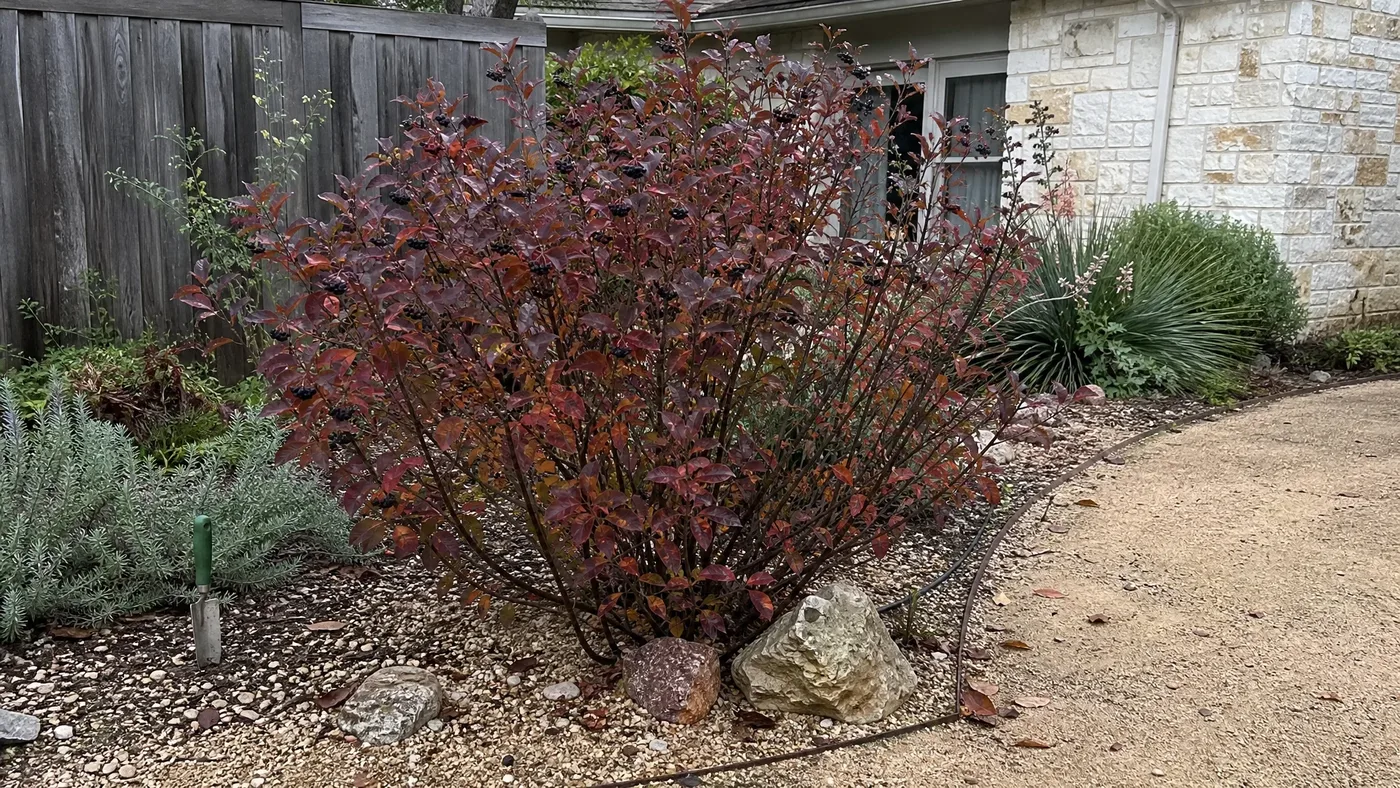
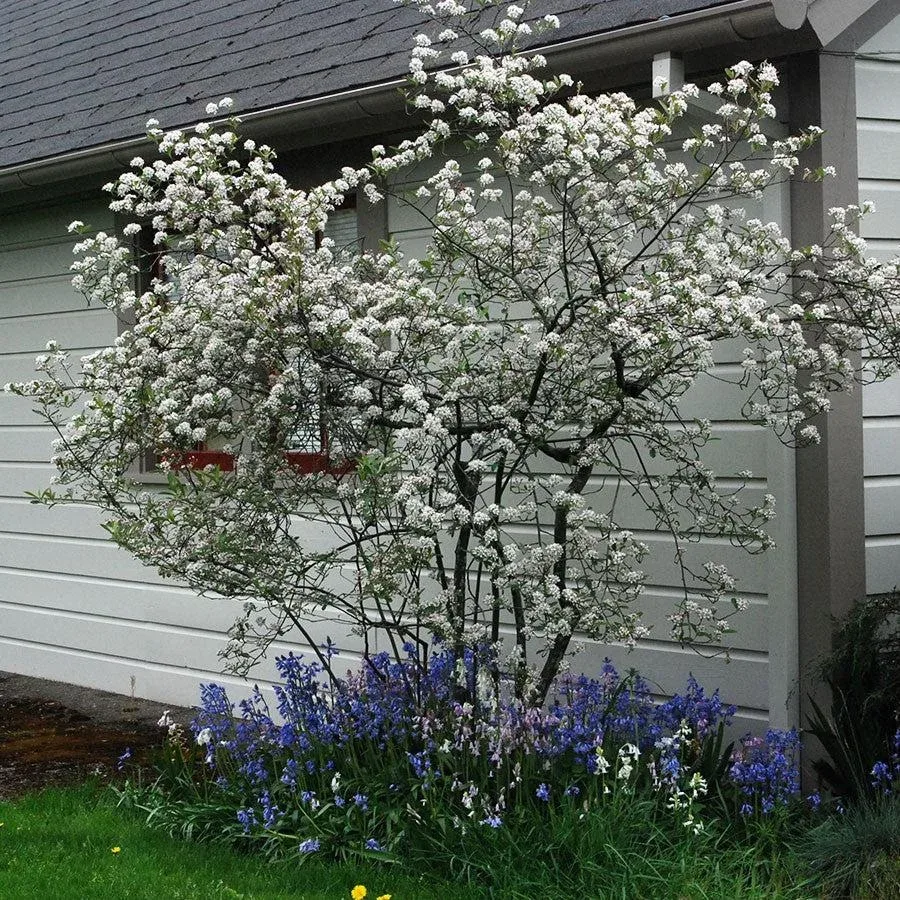
In May, fragrant clusters of white to light pink flowers open, each with red anthers. Butterflies and other pollinators work the flowers, and glossy red fruit follows. By October the leaves turn orange to bright red, and the berries can hang on through the winter. Our guide to chokeberry and wildlife goes deeper on who visits.
How Chokeberry Bush Spreads by Suckers
This is the part that worries people, so we stick to numbers where the sources give them and say plainly where they do not.
What the Sources Say
Suckers are new stems that rise from the root zone around the parent plant. The sources that mention them are measured in tone.
Red chokeberry may sucker and form a colony. Maryland's extension describes it as spreading by suckering, sending up new shoots near the base, and NC State recommends removing root suckers to prevent colonial spread. That is advice for gardeners, not an alarm about wild land.
Sizing the Clump
No source we trust gives a spread rate in inches per year, and we will not make one up. The size of the plant is the better guide.
A single plant grows slowly into a vase-shaped shrub 6 to 12 feet tall and 3 to 6 feet wide, and Oregon State gives 10 feet tall and 3 to 5 feet across. A colony is many of those stems standing together, not a runner racing across the lawn.
Managing Suckers by Hand
One of the most common questions we get is whether it will take over a border. In our rows, suckers show up close to the crown and thicken the clump from the edges.
Some advice treats any suckering shrub as a future weed. We disagree. Suckering is a habit you manage with a spade or pruners, and a common extension tip is to remove about a third of the oldest canes every year for vigor. Our chokeberry pruning guide shows how. Do it once a year and the clump stays the size you chose.
Seeds, Birds and Slow Colonies
Suckers move a plant a few inches at a time. Seed is how a plant jumps into new ground, so we look at what happens to the fruit.
Where the Seed Goes
The fruit is the seed's vehicle, and the sources say who comes for it.
Each glossy red pome holds one to five seeds, and the winter berries are eaten by mammals and birds, cedar waxwings, mockingbirds, thrashers, blue jays, vireos and sparrows among them. Birds are the likely carriers of seed away from the parent, as with any bird-eaten shrub. The berries are edible but so astringent they may cause choking, which helps explain why people leave many of them for wildlife.
What Holds Seedlings Back
Here is the key point: none of the extension sources we read describe red chokeberry seedlings escaping into natural areas as a problem in the United States.
We read that as a plant that spreads mostly by suckers, forming thickets close to where it started. Deer add a little to the brake, since the shrub has little resistance to deer and young stems take a beating in open country. The only introduced record in the distribution list we used is in the Netherlands.
If you want fewer berries on the ground or fewer sprouts anywhere, harvest the fruit or pull the seedlings. If you want birds to have the crop, leave it. Either way, expect the suckers to be the main thing you manage.
Nursery Plants and Wild Plants Differ in Origin
A shrub from a nursery and a shrub from a bog share a species name, but they arrive by different routes. This table sets out the differences that matter in your yard.
| Point | Wild plant | Nursery plant |
|---|---|---|
| Origin | Grown from seed or suckers in place | Propagated by growers from a selected parent such as 'Brilliantissima' |
| Variation | Differs from plant to plant | Closely matches the parent |
| Where it lives | Its own habitat within the native range | Wherever you plant it, in or out of range |
How Wild Stands Begin
Wild thickets build from seed and from suckers over many years.
Seed-grown plants vary in height, vigor and fruit, which is part of why the sources give size ranges as wide as 6 to 12 feet. No two wild stands look quite the same.
How Nursery Selections Are Made
'Brilliantissima' is a selection from the species, chosen for its compact habit, abundant fruit and flowers, and scarlet fall color. Growers multiply it by softwood cuttings or by potting up suckers, so every plant matches its parent.
Our chokeberry propagation guide walks through both methods. No source we use gives sucker rates for a particular cultivar, so we assume it behaves like the species and manage it the same way. Check the tag for Aronia arbutifolia, because a chokecherry is a different plant, as our comparison of chokeberry and chokecherry explains.
Please leave wild shrubs where they are. Local rules on collecting vary, and a nursery plant in a 2 gallon or 3 gallon pot is already started for a garden.
Chokeberry Bush Belongs Here and Stays Manageable
You asked for a choice, so here it is. If you garden in the eastern, southern or central states on the native list, we would plant red chokeberry freely. It belongs in your region, it feeds the wildlife around it and it keeps a manageable footprint with light pruning.
Inside the Native Range
This is the easy case, and we recommend it without reservation.
The shrub is native, and extension writers recommend it as a substitute for problem plants. University of Illinois Extension says both aronia species are listed as good replacement shrubs for invasive plants such as burning bush and Japanese barberry. For a hedge, a rain garden edge or a wild corner, it is among the safest natives you can pick.
Outside the Native Range
Hardiness runs wider than the wild range, so the answer needs one more step.
The plant is hardy in zones 3 to 9, so you can grow it in places where it is not native, Oregon among them. There it is an introduced plant, which is not the same as an invasive one. West Virginia's natural resources agency even features black and red chokeberry in its native alternatives for invasive shrubs. Invasive lists are set state by state, so call your local extension service before you plant in a new region.
Who Should Hesitate
One kind of gardener should think twice.
If you want a single clean mound with no maintenance, expect to remove suckers each year, or choose a different shrub. That is a design choice, not an ecological warning.
Chokeberry Bush by the Numbers
The recap is short: 27 native states plus Washington, DC, five Canadian provinces, zones 3 to 9, a single plant 3 to 6 feet wide, no spread rate in any source and no invasive listing in anything we read. Native, slow and manageable is the verdict.
Chokeberry Bush
Nursery-grown Chokeberry Bush in sizes from 2 GALLON, shipped to your door.
From $93.12
Shop Now →We grow our red chokeberry in open rows with room around every crown and cut back the suckers each year, so the clump habit is something we handle by hand before we pot and ship each shrub ourselves.