Is Chokeberry Bush a Tree or a Shrub?
A customer once sent us a photo of two shipping labels from two different sellers. One read "Red Chokeberry, deciduous shrub." The other read "Chokeberry, small tree, single trunk." Same plant, as far as we could tell, and the question underneath was simple: tree or shrub?
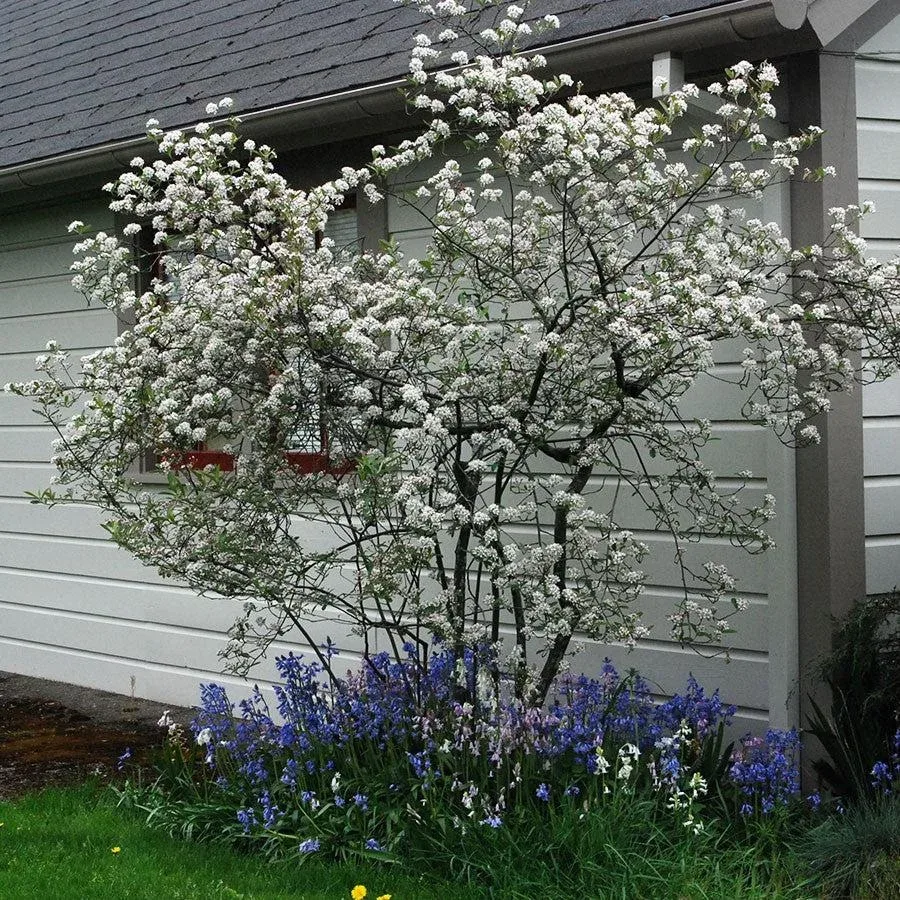
Our answer is a shrub, with one real exception. Red chokeberry grows from many stems and spreads by suckers. A tree form exists only because someone trains it that way and keeps training it. That upkeep decides whether the tree version is a good buy for you.
We'll walk you through where the name and the plant's history come from, then how it grows, what size to expect, and how a single-trunk form is made and kept. We finish with a short list to run through before you order.
Where the Name Chokeberry Bush Came From
The tree-or-shrub muddle starts with the name, so that is where we start. Nothing in "chokeberry" says anything about size or shape.
The name describes the fruit. The berries are edible but so astringent that they may cause choking, hence the common name. Taste one raw and you understand it at once, even though the red kind is sweeter than black chokeberry. Whoever first called it chokeberry was describing a dry, puckering mouthful, not a trunk.
Botanists took a different route. They filed the plant in the rose family, and our plant is Aronia arbutifolia 'Brilliantissima', the red chokeberry. Along the way it has also been listed under Pyrus, the pear genus, under Sorbus, and as Photinia pyrifolia, the name University of Maryland Extension still gives as its former one. A buyer who knows that pears and their relatives are trees tends to assume this plant will be one too.
That left two vocabularies for one plant. Everyday names followed what people tasted, and botanical names followed family. A nursery label can borrow from either, and neither one tells you whether the plant has one stem or twenty. "Bush" and "tree" are descriptions of habit, and habit is what the next sections settle.
Aronia's Path From Wild Thickets to Nurseries
Habit makes more sense once you see where the plant comes from. In the wild it is a plant of thickets, not of lone stately specimens.
Red chokeberry is found in wet and dry thickets in eastern Canada and the central and eastern United States. It copes with a wide spread of ground, from boggy soil that floods now and then to dry woodland edges. That background fits its hardiness, zones 3 to 9.
Gardens kept the features you notice from a path. In May there are clusters of white to light pink flowers with red anthers. In autumn the leaves turn orange to scarlet, and glossy red berries hang on into winter. Those seasons are why a thicket plant earned a place in the yard.
Nurseries then took the plant as it came, many stems and all, and sold it as a shrub. 'Brilliantissima' became the selection most of them grow, probably more than the species itself. The single-trunk "tree form" is a later trade development, a way of fitting the plant into a different category for buyers who want a small tree. We won't put dates on any of this, because we would be guessing.
How a Chokeberry Bush Grows From Many Stems
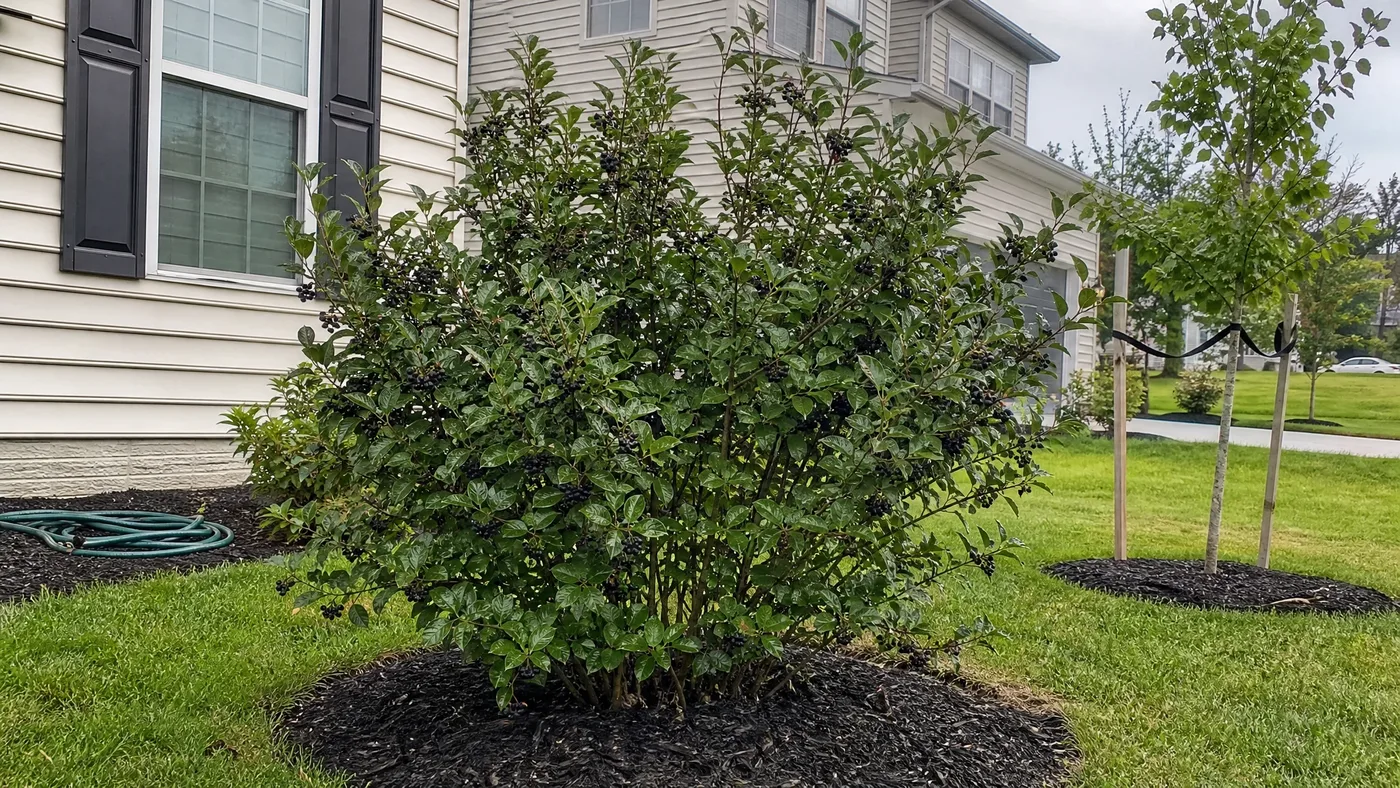
A tree has one dominant trunk with a crown above it. A shrub sends up several stems from the base. Red chokeberry does the second, and every source we trust agrees.
UConn describes it as a suckering, spreading, colonizing shrub with numerous, slender stems. It is multi-stemmed and vase-shaped, with a stiff, upright habit. So the stems come from the crown, and more shoots rise from the roots around it.
What the Base Tells You
The quickest check is at ground level, not in the canopy.
On a healthy plant you will see a cluster of stems of different ages, thick ones and thin ones, all leaving the soil in one area. Individual stems are upright and can be sparsely branched low down, which is why an older plant looks leggy at the bottom. A tree shows one trunk flaring into the ground. If you want to confirm the plant itself, our guide to identifying chokeberry by leaves, bark and look-alikes covers the rest.
How the Colony Builds
The visible stems are only part of the story, because the plant keeps spreading underground.
Over the seasons, suckers surface some distance from the original clump, and the planting grows wider as well as taller. Extension sources give a width of 3 to 6 feet for a single plant, and a colony can go past that. That is why we plan red chokeberry for beds and borders, not for a spot you mow right up to.
There is an upside. Many stems carry many flower clusters in May, followed by more red fruit, and 'Brilliantissima' is known for abundant fruit and flowers. A tree form gives up part of that show.
Six to Twelve Feet, Measured Honestly
Sellers quote different heights for the same plant, and the sources do too. Here is how we read them.
UConn says 6 to 10 feet tall and 3 to 5 feet wide. Oregon State lists up to 10 feet with a spread of 3 to 5 feet. UMass Extension gives 6 to 10 feet tall and 3 to 6 feet wide. NC State stretches the top end to 12 feet.
Those are species figures, and UMass describes 'Brilliantissima' as more compact than the species. What we tell customers is to plan on 6 to 12 feet in height and 3 to 6 feet in width, and to place the plant where the upper end would not be a problem. The plant is slow growing, so you will have years of warning before it gets there.
What Moves a Plant Within the Range
Four things decide whether a plant lands near the bottom of the range or the top.
- Light. Full sun gives the best flowers and fruit and partial shade is tolerated, so where you plant it is part of the size answer.
- Soil. Maryland lists any soil texture, clay included, from dry to wet, as long as it is acidic, so soil rarely caps the plant the way it does for fussier shrubs.
- Pruning. Stems you thin out or cut back after flowering stay shorter than stems left alone.
- Suckers. They add width more than height, so spread is the number that changes most over the years.
Our guide to chokeberry size and growth rate covers how quickly a plant gets there.
Why Nurseries Sell a Single-Trunk Chokeberry Bush
A single-trunk chokeberry is real, and the people selling it are not inventing anything. They are describing how that plant was grown, not how the plant grows by nature.
The reasons are practical. A trunk lifts the flowers, scarlet fall leaves and red berries to eye level, leaves room underneath for smaller plants and suits a buyer who searched for a "small tree." Some growers make it by training one stem, and a label may not say exactly how the trunk was made.
Some listings call the result a small tree outright. We would call that shorthand. Underneath, the genetics are still those of a suckering shrub, and the plant will try to behave like one.
What to Check Before You Order
A few questions separate a well-grown tree form from a shrub with its lower stems trimmed off.
- Ask whether the trunk is trained from the plant's own stem or grafted, and how tall the clear trunk is.
- Confirm the label names Aronia arbutifolia, ideally 'Brilliantissima', and not just "chokeberry tree."
- Look at the base for fresh suckers. Many suckers on a young plant tell you how much work is coming.
- Check that the trunk is straight, firm and staked, and that the size matches the container, which our container size buying guide explains.
- Ask what the listed mature height refers to, the tree form or the species.
If a plant is grafted, shoots from below the union can come from a different plant than the top. Identify them before you decide a sucker is harmless.
Training a Chokeberry Bush Into One Trunk
If you want the tree form, you can build it yourself or keep up one you bought. The method is simple. The work never fully ends.
Setting Up the Trunk
Do these steps in order, starting in the first growing seasons after planting.
- Choose the straightest, strongest upright stem and mark it with ribbon so you do not cut it by mistake.
- Cut every other stem off at ground level. Leave no stubs, because stubs resprout.
- Stake the trunk loosely so it grows straight, and loosen the ties as it thickens.
- Keep short side shoots on the lower trunk for now, since they help it thicken, then remove them gradually up to the height where you want the head to start.
- Let the top branch out above that point and shape it lightly after flowering.
Removing Suckers on Schedule
Suckers are the real job, and they come back every year.
NC State recommends removing root suckers to prevent colonial spread, and on a trunk plant that advice becomes the whole routine. We make our main pass right after flowering. Then check the base whenever you water or mow, and cut each new shoot as close to its origin as you can reach. Our chokeberry pruning guide covers the cuts in more detail.
One of the most common questions we get is whether the suckers ever stop. In our experience they don't. A rooted sucker can be dug and potted, which our guide to propagating chokeberry by division or cuttings explains, so the work is not wasted.
Advice to prune once a year is fine for the shrub. For a trunk plant it produces a thicket by midsummer.
Treat It as a Shrub, Shape It Only on Purpose
Here is the rule we give customers: plant it as a shrub, and choose the tree form only if you will keep up with it.
The table sets the two forms side by side so you can see what each one asks of you.
| Feature | Shrub form | Single-trunk form |
|---|---|---|
| Stems | Many, from the base | One, all others removed |
| Suckers | Allowed to fill in, or thinned at the edge | Removed every time they appear |
| Look | Full and vase-shaped, flowers, berries and fall color from the ground up | Bare base, color held up at eye level |
| Upkeep | Thinning the oldest stems after spring flowering | Pruning, staking and regular sucker checks |
| Best for | Beds, borders, hedges, wet or dry spots | One accent spot you pass often |
We would choose the shrub for nearly everyone. It matches how the plant wants to grow, gives you the fullest bloom, the most berries and the deepest fall color, and asks for one pruning pass a year.
The tree form earns its place in one situation: a single accent spot, close to a door or path, where you will see every new sucker the day it appears. If that is not you, you are better off letting red chokeberry be a shrub.
Before You Order Your Chokeberry Bush
Confirm the label says Aronia arbutifolia, decide between a shrub of about 6 to 12 feet tall and 3 to 6 feet wide or a single trunk, and if it is a trunk, ask how it was made and check the base for suckers. Then put the sucker pass on your calendar for right after flowering, pick a form and stick with it.
Chokeberry Bush
Nursery-grown Chokeberry Bush in sizes from 2 GALLON, shipped to your door.
From $93.12
Shop Now →We grow 'Brilliantissima' in full sun on its many stems and ship it ourselves in 2 gallon and 3 gallon pots, because we would rather sell a well-grown shrub honestly than call it something it is not.