Identifying Chokeberry Bush: Leaves, Bark and Look-Alikes
Hold a red chokeberry leaf and a buckthorn leaf in the same slanting afternoon light and both will flash, because both are shiny dark green above. Gloss alone settles nothing, and that is the first lesson in telling Aronia arbutifolia from the shrubs that crowd around it.
Getting it wrong has real costs. A forager may pick the wrong red fruit, and a gardener may bring home a suckering buckthorn that can reach 25 feet when a 6 to 12 foot chokeberry was the plan.
This guide walks you through identifying red chokeberry, the plant we grow, from leaf arrangement, fuzzy undersides and midrib glands to bark, flowers, berries and the way the shrub changes through the year, with a short confirmation routine at the end.
Chokeberry Bush Leaves Against Buckthorn Leaves
Leaves are where most mix-ups start, and two checks end them: how the leaves sit on the twig, and what runs along the midrib. Both take under a minute on a shrub in leaf.
Check How the Leaves Attach
Start at a growing tip and look at the twig, not at a single leaf pulled out of context.
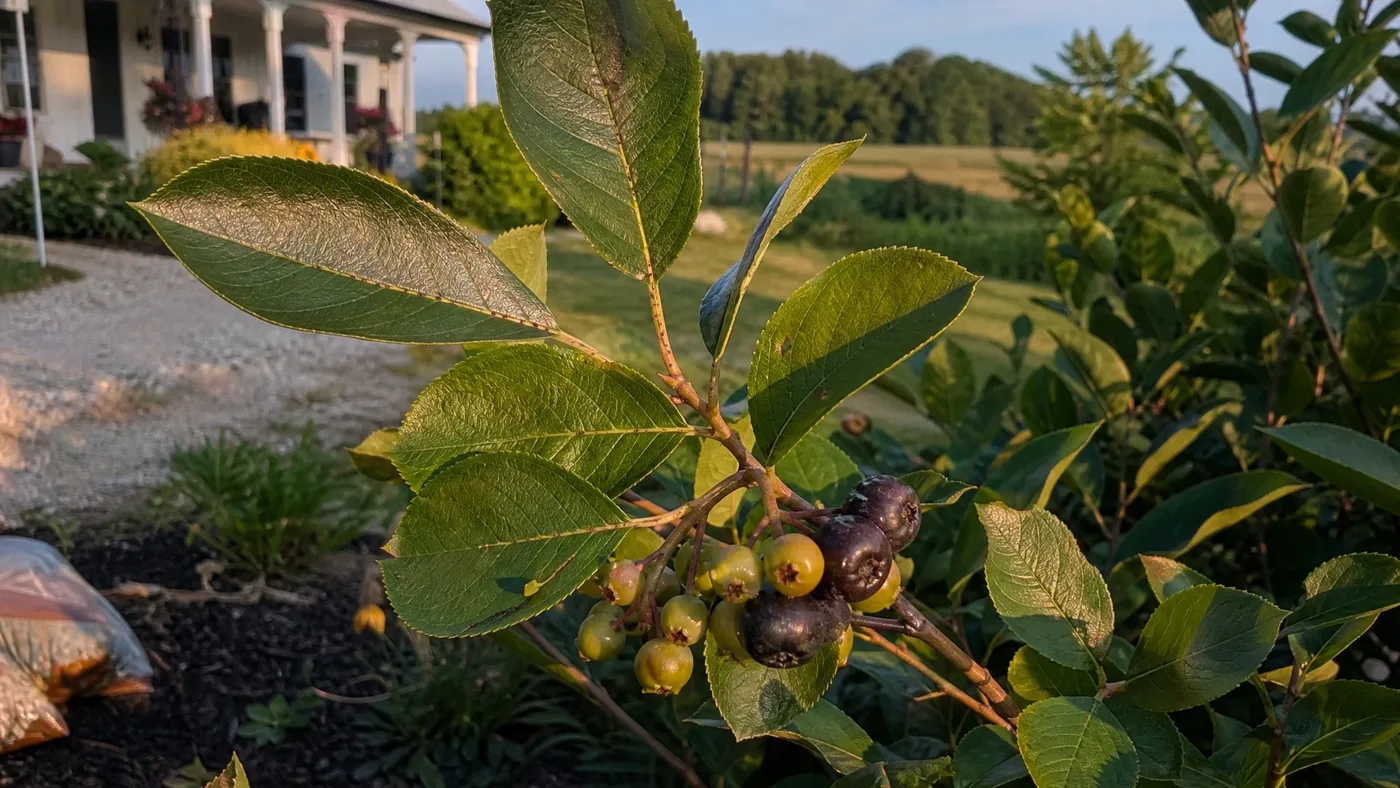
Red chokeberry leaves are alternate and simple, one leaf per node, stepping up the twig like a loose staircase. They are elliptical, oblong or obovate (widest above the middle), about 1 to 3½ inches long, with finely serrated edges. Common buckthorn leaves are opposite or sub-opposite, meaning paired or nearly paired, and run 2 to 3 inches long.
Because "sub-opposite" means partly alternate, never decide from one node. Walk your eye along four or five nodes. Then turn a leaf over: a red chokeberry leaf is grayish green and fuzzy underneath, soft enough to feel with a fingertip. Buckthorn is described only as much lighter below, so a pale underside is a prompt to recheck the arrangement, not proof by itself.
Find the Dark Glands Along the Midrib
This is the trait we trust most, because none of the other look-alikes in this guide are described as having it.
Hold a leaf face up and look along the upper midrib. Red chokeberry carries stiff, raised dark glands there, and you may need a hand lens to see them. Run a fingernail lightly down the vein and you will feel a slight rasp. In our rows we often see the glands first as a faint dark seam when the light comes in low and from the side.
Skip vein patterns as a deciding clue. Arrangement, the fuzzy underside and the glands are firmer ground.
Weigh Gloss, Size and Habit Together
Once arrangement and glands agree, step back and let the whole plant confirm what the leaf told you.
Both shrubs have a polished upper surface, so the gloss that catches your eye from across a yard is shared. What differs is the plant behind it. Buckthorn is a large, suckering shrub or low-branching small tree up to 25 feet, while red chokeberry stays a vase-shaped, multi-stemmed shrub of 6 to 12 feet. A plant with paired leaves and a trunk heading well over your head is not the shrub you are looking for.
Black chokeberry, the red's close relative, shares the alternate leaves and midrib glands. The quick split is underneath: black chokeberry leaves lack hairs below, while red chokeberry leaves are fuzzy.
Smooth Reddish Bark Next to Black Cherry Scales
Bark and twigs let you identify a chokeberry bush in winter, and they separate it from black cherry faster than any leaf check does.
Read the Chokeberry Bark and Twig
Red chokeberry bark is reddish brown, thin and smooth, dotted with lenticels (the small pores that look like pale dashes), and it develops diamond-shaped splits and turns grayish brown as it ages. The young twigs are slender, reddish brown and generally fuzzy, with narrow leaf scars. The terminal buds are long, 1/3 to 1/2 inch, and they look much like serviceberry buds.
Set that against a shrub of 6 to 12 feet with several upright stems, and you have a fine-textured plant with warm-toned bark.
Spot the Black Cherry Difference
Black cherry is a tree, and its older bark is dark and curls into scales, the "burnt potato chip" look. Even young cherry stems will not give you the smooth reddish chokeberry surface for long.
Check the leaf underside as well. Black cherry shows orange hairs underside along the midvein, while red chokeberry is grayish and fuzzy across the whole underside. If your confusion is with the similarly named fruit shrub rather than the tree, our comparison of chokeberry and chokecherry covers that pair.
Rule Out Buckthorn Under the Surface
Young buckthorn bark can fool you, since it is smooth, shiny and gray to reddish brown with lenticels, just like a chokeberry stem.
The giveaways come later. Buckthorn bark turns dark gray and scaly, and its inner bark is yellow. Twigs that often end in a sharp thorn are another sign. Check a fallen or pruned twig for the yellow layer rather than wounding a healthy stem. If thorns are your deciding question, our page on whether chokeberry has thorns goes into it.
Chokeberry Bush Flowers in Shade, Then in Sun
Spring flowers help you confirm the shrub, but light changes how they read, so judge them in both settings before you decide anything.
Learn the Flower Itself
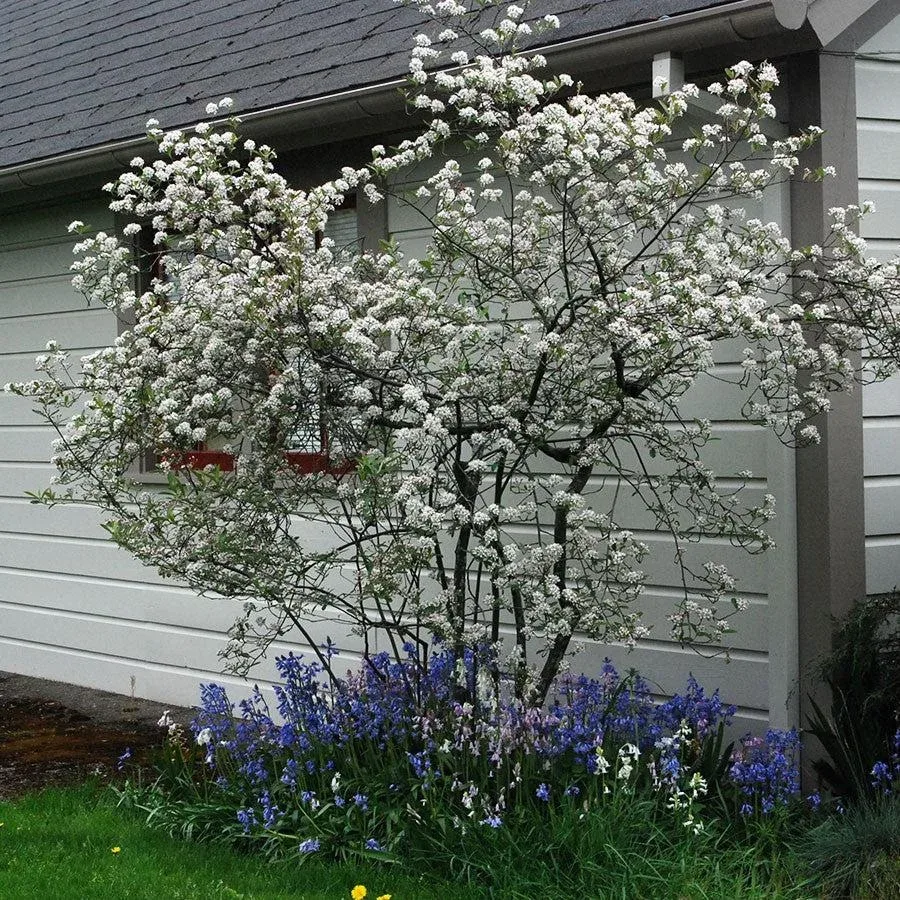
The flowers are white to light pink, with five petals and red anthers, held in flat-topped clusters along the branches. Each small cluster holds 9 to 20 flowers by Oregon State's count, and they open in May. Our guide to when chokeberry blooms covers the details.
Judge Color in Shade and in Sun
Here is how the same cluster tends to look under each condition, and why you should not trust a first glance.
In shade, the white petals glow against the dark foliage and the anthers are easy to miss. In full sun, petals bleach toward flat white and the red anthers stand out clearly. Red chokeberry tolerates part shade, so you may find plants in either setting. Step into even light, or tilt a cluster toward you, before you call the color.
Tell It From Serviceberry Blooms
Serviceberry shares the alternate, finely serrate leaf and the long buds, which is why the two get confused.
The flowers are the quickest split. Serviceberry has long, strap-like white petals in elongated, drooping bunches, while chokeberry's small cupped flowers sit in flat clusters. Scale helps too. Downy serviceberry can reach 40 feet with a narrow crown, and its young bark is ashy gray with darker stripes, while chokeberry stays reddish brown.
Glossy Red Berries Beside Other Red Fruit
Ripe berries make the fastest eye-level test, provided you look past the color. Several native shrubs carry red fruit into fall and winter, so three habits keep you honest.
Judge the Shape and Season, Not Just the Color
Red alone narrows little, because more than one shrub in this guide carries red fruit.
Red chokeberry fruit is a small, shiny red pome, ¼ to ⅓ inch across and round to slightly pear-shaped, ripening between September and November and frequently staying on the branches into winter. Serviceberry fruit is red to purple and ripens in early to mid summer, so a shrub loaded with ripe fruit in June is probably not a chokeberry. If the fruit is black, you are looking at black chokeberry or something else entirely.
Note Where and How the Fruit Sits
Position gives a second opinion on the color.
Red chokeberry fruit forms dense clusters along the branches, at eye level on a shrub you can reach. Winterberry holly, a native red-fruited shrub that is easy to confuse with it in winter, holds its berries in clusters appearing like whorls at the nodes, striking on bare stems. Its bark is gray to blackish, and its leaves are not described with midrib glands, so a twig with reddish bark and fuzzy alternate leaves fits chokeberry and one with gray bark does not.
Keep Taste Out of It
Never use taste as an identification test. Red chokeberry fruit is edible but so astringent it may cause choking, and winterberry fruit carries a low severity poison note. An unidentified berry should stay unidentified until your checks are finished. Once you are sure, our guide to cooking and eating chokeberry berries picks up from there.
Guessing From Afar, Then Checking Up Close
Most misidentifications come from shortcuts: a glance across a field or a single photo. This table pairs each common shortcut with the check that replaces it.
| Shortcut | Better Check |
|---|---|
| Calling it by gloss | Both red chokeberry and buckthorn are shiny above, so check leaf arrangement and the midrib glands instead. |
| Guessing from height | Sources give 6 to 12 feet and up to 10 feet for red chokeberry, so height overlaps with other shrubs. Check the twig and bark. |
| Trusting one leaf | Look along the twig for several nodes. Buckthorn can be sub-opposite. |
| Going by red berries | Winterberry and serviceberry also carry red fruit. Feel for the fuzzy underside and look for the glands. |
| Going by red autumn color | Many shrubs turn red. Use the twig, buds and bark. |
Take Photos That Answer the Question
One of the most common questions we get is a photo of a single shiny leaf with "is this chokeberry?" underneath, and we cannot answer it from that alone.
Send or keep four views instead: the whole shrub, a twig showing how the leaves attach, the underside of a leaf, and a close-up of the upper midrib. Shoot in even, open shade if you can, since hard sun flattens the glands and washes out the stem color.
Keep Identity and Health Questions Apart
A photo often shows spots, curling or chewed edges, and people read those as identity clues.
They are not. Damage can appear on any shrub in the group, so it tells you nothing about which one you are looking at. Identify first, then turn to our guide to chokeberry problems, pests and diseases if the leaves look unhappy.
Chokeberry Bush in Spring Light, Then Autumn
The same shrub can look like two different plants across a year, and a clue that works in June may be gone by October.
Read Spring and Summer Foliage
In spring, soft new leaves and white flower clusters make the shrub light and open. By summer the leaves settle into glossy dark green, which is when the midrib glands are easiest to find. This is the best window for the leaf checks above.
Don't Let Autumn Red Mislead You
Autumn color is dramatic, and it fools people because so many shrubs turn red. Red chokeberry colors up in October, orange first and then bright red, with 'Brilliantissima' at the scarlet end. Our guide to why chokeberry turns red in fall explains the change.
Treat the red as a pleasant extra, not a test. A hedgerow in October can hold three or four shrubs in nearly the same red, and only the leaf arrangement and the stems will sort them.
Switch to Twigs Once the Leaves Drop
Bare branches give you a different set of clues, and they do not change with the light.
Look for reddish brown, fuzzy twigs, long terminal buds and narrow leaf scars, often with a few red berries still hanging on. The buds resemble serviceberry, so do not stop there. Check the bark for smoothness and diamond-shaped splits, and size up the plant: a multi-stemmed shrub points to chokeberry, and a taller one with ashy, furrowed bark points to serviceberry.
Confirming Your Chokeberry Bush Beyond Doubt
Use this short routine in order. Each step rules out a different look-alike, and together they settle the question.
- Check four or five nodes along a twig and confirm the leaves are alternate, not opposite, which rules out buckthorn.
- Turn a leaf over and confirm the whole underside is grayish and fuzzy, not just orange hairs along the midvein, which rules out black cherry and black chokeberry.
- Look along the upper midrib with a hand lens and find the stiff, raised dark glands.
- Inspect the twig for a slender, reddish brown, fuzzy surface with narrow leaf scars and long terminal buds.
- Look at the bark for a smooth reddish brown surface with lenticels, and on a fallen twig, no yellow inner layer.
- Compare the size with a multi-stemmed shrub of 6 to 12 feet, not a tree.
If any of the first three steps fail, stop and take a cut twig to your local extension service. A very young plant has little bark to read, so lean harder on the leaves and glands, and look again after a season of growth.
Chokeberry Bush Seen Clearly
Alternate leaves separate red chokeberry from buckthorn, the fuzzy underside and smooth reddish bark separate it from black cherry, and flowers, fruit season and scale separate it from serviceberry and winterberry. Picture the confirmed shrub in low morning light: glossy leaves, reddish stems and clusters of shiny red fruit. Before anything else, run a lens along the upper midrib and look for the dark glands.
Chokeberry Bush
Nursery-grown Chokeberry Bush in sizes from 2 GALLON, shipped to your door.
From $93.12
Shop Now →Customers tell us the shrubs they get from us match what they read here, with the glossy leaves, reddish stems and bright red fruit this guide describes. We grow every 'Brilliantissima' ourselves and ship it in 2 gallon and 3 gallon pots.