Does Chokeberry Bush Have Thorns? Here's the Answer
Run a bare hand down a bundle of red chokeberry canes in a wet thicket and you find nothing to snag. A naturalist notes this at once, because it is unusual for a native shrub in ground so full of briars.
The question we hear most is a plain one: does chokeberry bush have thorns? The short answer is no. The longer answer is worth having, because several shrubs that share its wet edges are armed, and a few look enough like it to cause doubt.
This guide covers thorns on red chokeberry 'Brilliantissima' from every angle, from how the stems look and feel to the wild neighbors that do bite, the look-alikes to watch for, and where an unarmed shrub earns its place in a yard.
Chokeberry Bush Stems Are Smooth and Unarmed
Red chokeberry carries no thorns, spines or prickles anywhere on the plant. Here is what your hand will find on the wood, and how that changes through the year.
Canes and Twigs
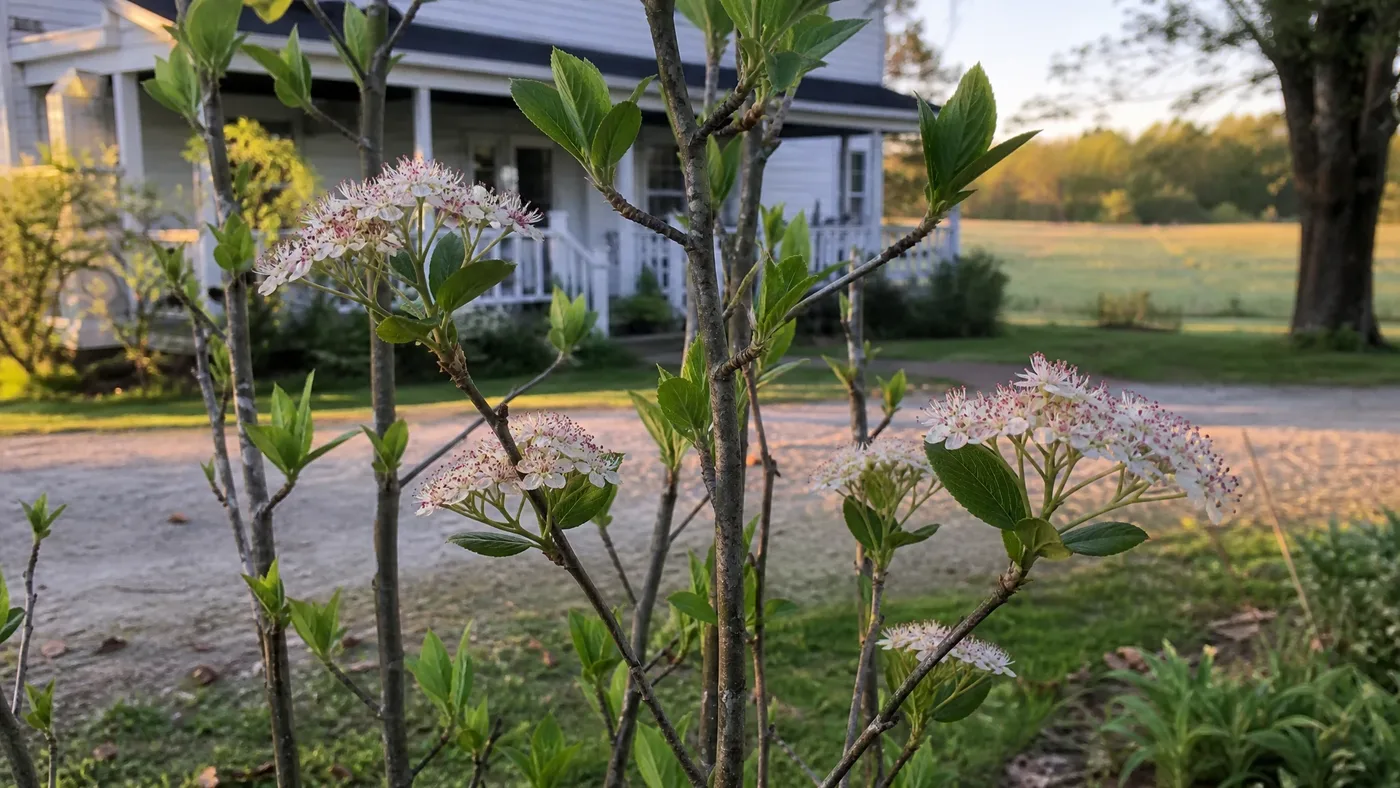
The upright canes are slender, and NC State Extension describes the bark as reddish-brown, thin, smooth, and exfoliating, turning grayish-brown as the shrub ages. Young twigs are brownish red and soft with fine hairs, which the University of Richmond's tree pages call densely tomentose twigs. Slide a palm along one in either direction and you feel only that light fuzz and the faint scars where leaves once sat.
Twigs end in a soft, pointed bud, bright red on this species, never a sharp tip. Side shoots leave the cane at a shallow angle and are as smooth as the main stem. Even on old, leggy canes, which this shrub tends toward, the wood does not grow armor late in life. That holds whether the shrub is a young 2 gallon plant or a mature clump 6 to 12 feet tall.
Leaf Bases and Buds
The leaves are simple, finely toothed and glossy on top, with a grayish, hairy underside that feels soft, not rough. A row of small, slender dark glands runs along the midrib on the upper surface. The leaf stalk joins the twig with no spine at its base, and the buds sit close against the stem rather than on a spur.
Reading the Smooth Wood Through the Seasons
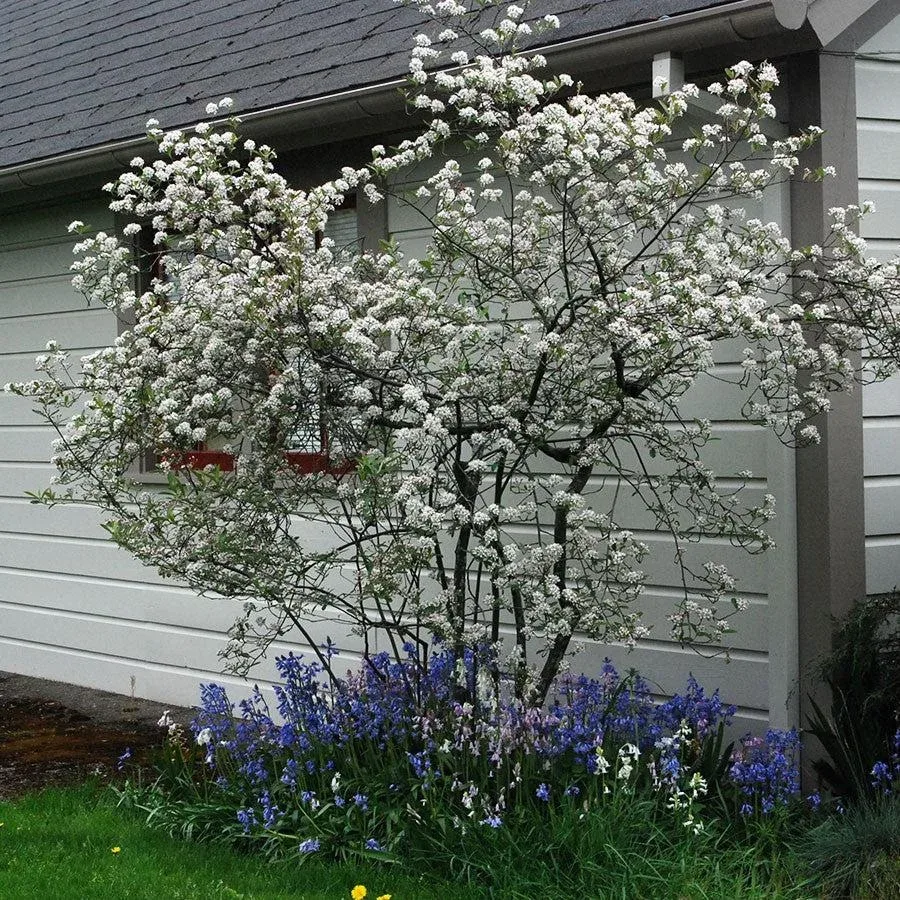
Winter is the best time to confirm all this. With the foliage gone, the bare canes show that nothing hides along them, and glossy red berries often still hang on the twigs. May brings clusters of white to light pink flowers with red anthers on that same clean wood, and in autumn 'Brilliantissima' turns what Oregon State calls an excellent scarlet fall color.
The stems carry no hazard in any of those seasons. Our guide to identifying chokeberry bush covers the leaf and bark details in full.
Thorns and Prickles Are Not the Same Thing
People use "thorny" for anything that scratches, but botanists separate three kinds of armor. Knowing the difference tells you exactly what chokeberry lacks.
Thorns, Spines and Prickles
A thorn is a modified stem. It grows from a bud position, contains woody tissue and is hard to snap off, as on a hawthorn. A spine is a modified leaf or leaf part, such as the sharp tips on a barberry. A prickle is a sharp outgrowth of the bark surface only, which is why blackberry and rose prickles can be peeled away from the cane.
What Chokeberry Skips
Red chokeberry has none of the three. No stem has been turned into a point, no leaf into a barb, and the bark has not grown hooks. That matters because a shrub can be free of thorns and still bristle with prickles, and some "thornless" plants are only spine-free.
Chokeberry belongs to the rose family, the same large family that holds some of the most heavily armed shrubs in the countryside. Its smooth wood is therefore the exception in its own family and not a family trait, so you cannot judge it by its relatives.
Why the Distinction Helps You
If a plant tag or a neighbor says "thornless," ask which kind of armor is meant. For red chokeberry the answer is all of them. You can strip leaves, bend canes and cut out old wood with the same bare grip, which is rarely true of anything else in the rose family.
Wild Neighbors Carry the Weapons, Not Chokeberry Bush
Red chokeberry is native to eastern Canada and the central and eastern United States, where it grows in wet and dry thickets and along swamp margins and woodland edges. Those places are crowded with armed shrubs, and since this species tolerates wet sites and occasional flooding, it often sits right among them.
The Armed Shrubs of the Same Edges
The table below lists the shrubs people most often meet in the same ground and what each one carries.
| Shrub | What it carries | How it differs from chokeberry |
|---|---|---|
| Hawthorn | True thorns, stiff and sharp, set along the twigs | Chokeberry twigs end in soft buds |
| Blackberry | Curved prickles that hook skin and sleeves | Chokeberry canes are smooth along their whole length |
| Multiflora rose | Paired, recurved prickles on arching canes | Chokeberry has no hooks and holds an upright, vase-shaped form |
| Buckthorn | On some species, a sharp point at the twig tip or spur | Chokeberry never ends a twig in a point |
How Chokeberry Holds Its Ground Instead
Red chokeberry sits among these without any defense. It spreads by suckers instead, sending up new shoots from the roots until a single plant becomes a colony. In a garden, that is the habit you manage, and the usual advice is to remove root suckers if you want to stop the spread.
Its astringent fruit may also keep some feeders away early in the season, since the berries are so sharp on the tongue. Spreading underground is how it keeps its patch, with no armor involved.
In our rows, customers often ask whether a shrub with sharp stems in a roadside ditch could be chokeberry. It almost never is, because a sharp stem tells you right away that you are looking at something else.
Birds Nest Safely in Chokeberry Bush Canes
Many shrubs lean on thorns to keep predators off a nest. Chokeberry offers shelter built from density and structure instead.
Cover Without Spines
A mature clump sends up many close, upright canes that open into a vase shape with a leafy top. That gives small birds a screen of foliage and plenty of forks to build in. Because the wood is unarmed, nothing snags a wing on the way in or injures a fledgling hopping through the stems.
Unarmed cover has a cost, since a nest here has no thorn barrier against a determined predator. Exact nesting use varies by region and bird, so watch your own planting to see who moves in.
Flowers and Fruit for Visitors
The flowers open in spring in clusters of white to light pink blooms with red anthers. NC State gives May as the bloom month, and the University of Maryland Extension lists white flowers from March to May, so timing shifts with your region. Butterflies, bees and other small pollinators work the open, flat flowers for nectar while the shrub is in bloom.
The glossy red berries ripen in fall and may hang on through the winter, when mammals and birds eat them. They are edible but so astringent they may cause choking, which is how the plant got its name. A clump left unpicked gives birds a berry supply deep into the cold months.
Our guide to chokeberry and wildlife goes through who visits and when.
Thornless Does Not Mean Deer-Proof
A common assumption is that only armed shrubs escape browsing, and the reverse is also assumed, that an unarmed shrub is always eaten. For red chokeberry the second is closer to the truth, because it has little resistance to deer damage. If deer pressure is heavy where you live, plan on protecting young plants.
Chokeberry Bush Look-Alikes Can Fool You at a Distance
From across a field, a red-fruited shrub with white spring flowers can be several different plants. Up close, a few traits settle it quickly.
Unarmed Cousins
The closest relative is black chokeberry, which is also unarmed. The two differ most in fruit color, glossy red on our plant and near black on the other, and red chokeberry's gray, hairy leaf undersides help too. Our black chokeberry and red chokeberry comparison sets this out.
Chokecherry is a different plant altogether, with longer flower spikes and a different fruit. We cover it in our chokeberry versus chokecherry page. Neither of these is a thorny stranger, so a mix-up costs you nothing.
Thorny Strangers
The real danger of confusion runs the other way. A thorny stranger can pass for red chokeberry if you look only at the flowers or berries. Hawthorn carries white spring blooms and small red fruit on many species, and buckthorn has small dark berries that sit beside chokeberry in mixed hedgerows. Both can look right from a distance, and both can hurt a hand that reaches in unwarned.
The Stem Check
Before you trust the flowers or the fruit, run through this short check on the wood itself.
- Slide a bare palm along one cane. If anything catches, snags or pricks, it is not chokeberry.
- Look at the twig tips. Chokeberry ends in a soft red bud, never a point or a spur.
- Check where the leaf meets the stem for any spine or paired barbs.
- Turn a leaf over. Red chokeberry has a grayish, fuzzy underside and fine teeth along the edge.
- Look at the form. An upright, vase-shaped clump of smooth canes is the chokeberry pattern.
Unarmed Stems Make Chokeberry Bush a Friendly Pick
A shrub without thorns changes where you can put it. Most of the practical gains show up where people and plants meet.
Paths, Hedges and Play Areas
Red chokeberry can go beside a walkway, a gate or a patio, where branches will brush shoulders and sleeves without harm. Give it room, since it grows 3 to 6 feet wide. Children and dogs can pass through the stems without trouble. Dense clumps work as a screen or loose hedge, and the species is hardy in zones 3 to 9, so the choice is open across a wide range of yards.
It suits borders, rain gardens and open wooded gardens, and it looks best in a group, since single plants get leggy with age. For ideas on placement and partners, see our landscape ideas for chokeberry bush.
Pruning and Harvest
Pruning a thorny shrub means long sleeves and heavy gloves. Chokeberry needs neither for the plant itself. You can reach into the center of a clump to cut out an old cane with a bare hand, and picking fruit for jam or jelly does not mean fighting through hooks. The timing and method are in our pruning guide for chokeberry bush.
A Note on Pets and Children
Smooth stems solve the scratching problem, but they say nothing about what happens if a berry is eaten. The sources describe the fruit as edible but very astringent raw. For anything more specific about pets, check our page on whether chokeberry is toxic, and ask your vet.
Smooth Wood Is the Rule for Chokeberry Bush
Red chokeberry has no thorns, no spines and no prickles. That is true of the canes, the twigs, the buds and the leaf bases, and it does not change with age or with how much sun the plant gets.
For a buyer, that settles one question and leaves others open. You can put it near a path, a bench or a play area without worrying about what the stems will do. You still have to think about its spread, its height, its sun and its soil. Nothing about the wood itself should hold you back.
Running a Bare Hand Along Chokeberry Canes
The one real snag around a chokeberry is not a thorn. It is the crop of suckers underfoot, which can trip a boot or catch a pant leg when the clump is left to spread. Cut or mow them back and the patch behaves. If you still doubt that the shrub is unarmed, run a bare hand along a smooth cane and see for yourself.
Chokeberry Bush
Nursery-grown Chokeberry Bush in sizes from 2 GALLON, shipped to your door.
From $93.12
Shop Now →Customers come back to us for red chokeberry that gives them spring flowers, scarlet fall color and red winter berries without a single scratch along the way. We grow and ship these shrubs ourselves, and this is one we are glad to hand over.