Black Chokeberry vs Red Chokeberry: Which Should You Plant?
If you are standing in a garden center aisle holding two tags that look almost identical, take a breath. You have not found a trick question. Many people assume black chokeberry and red chokeberry are the same shrub with different berry colors, and that either one will behave the same way in the yard.
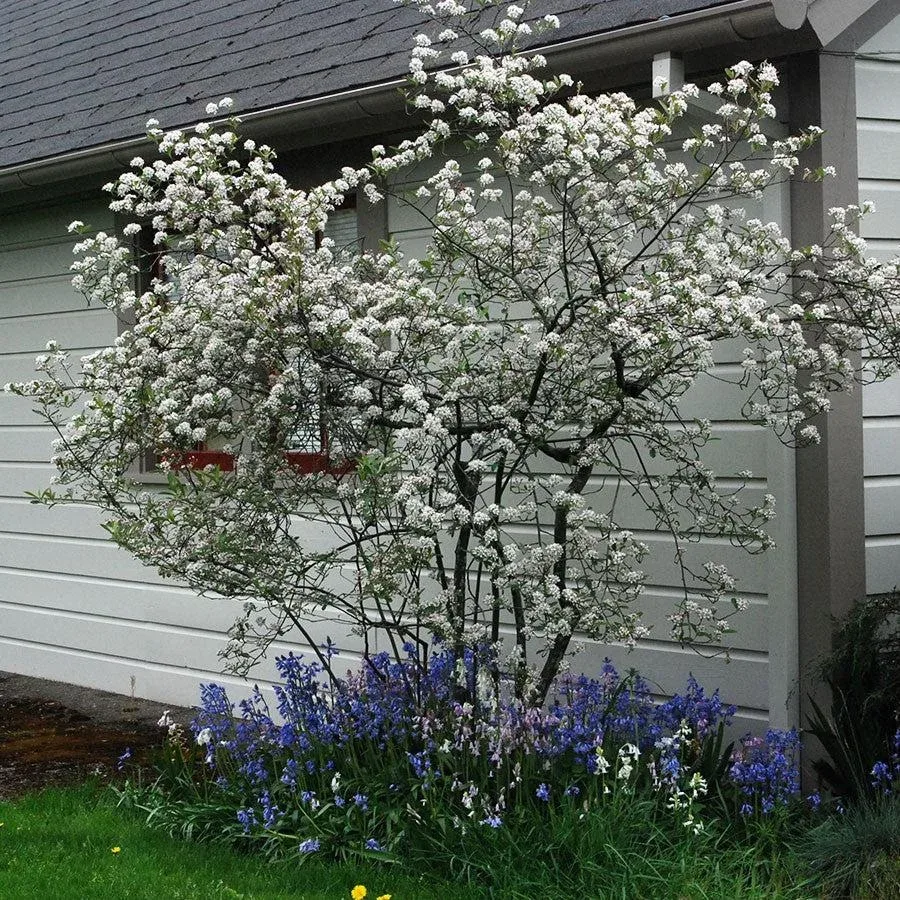
What we see instead is two close cousins with real differences. One usually stays a tidy, rounded shrub, and the other grows into a tall, upright screen. We grow and sell the tall one, red chokeberry 'Brilliantissima', but black chokeberry is the better pick for some yards, and we say so where it is.
This article compares black chokeberry (Aronia melanocarpa) and red chokeberry (Aronia arbutifolia) on height, fall color, winter berries, soil, upkeep and landscape use, and answers the questions customers ask us most. Read on to learn which one suits your space, and why a wrong guess usually shows up as a shrub far taller or wider than you planned.
How Tall Will Your Chokeberry Bush Get?
Height is the first difference you will notice, and the one that surprises people most a few seasons after planting. Here is how each plant sizes up.
Black Chokeberry in Small Spaces
Black chokeberry is the shorter of the two and the one that fits most small gardens.
The University of Maryland Extension gives it 3 to 6 feet tall, while Minnesota's extension allows 3 to 8 feet and NC State says up to 10. Width runs 2 to 6 feet in the Minnesota figures. The range is wide because site and age both push it. Dwarf black selections stay at about 3 feet or less. What we tell customers is to plan for the lower end, and to check with your local extension service before you tuck a full-size one under a low window.
A shrub in that size range sits comfortably beside a porch, along a walkway or at the corner of a bed. You can walk past it in spring without ducking and still look down into the flower clusters.
Red Chokeberry for Larger Spaces
Red chokeberry plays in a different league on height.
Red chokeberry grows in a vase-shaped form to 6 to 12 feet tall and 3 to 6 feet wide. Black chokeberry can reach 8 to 10 feet, so a modest red chokeberry is shorter than the tallest black one, while a mature red one is usually taller. Red is slow growing, so the 2 gallon and 3 gallon plants we ship take several seasons to reach full height.
Because the shape is upright and narrow rather than rounded, red chokeberry reads as a vertical element. It suits a corner where you want something to rise, not a bed under a window.
Our verdict: black chokeberry for small and medium yards, red chokeberry where you have real height to fill. That is the job we grow 'Brilliantissima' for. Our guide to chokeberry size and growth rate covers the growth timeline in more detail.
Fall Color You Will Notice From the Window
Both shrubs turn in autumn, and both are worth planting where you can see them from inside. They do not turn in quite the same way, though.
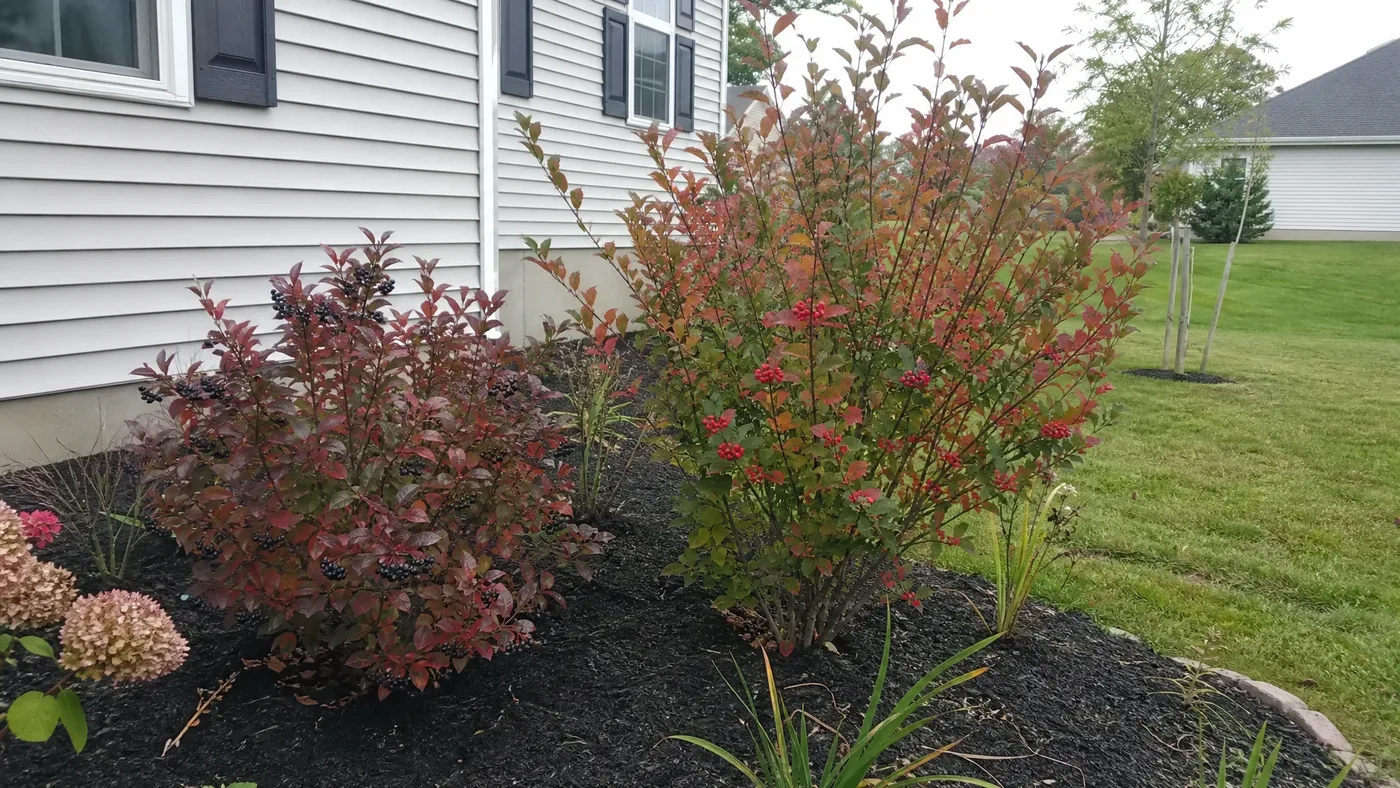
Black chokeberry leaves change from green to vibrant tones of red, orange and purple, often settling into crimson and burgundy. That spread of colors means one shrub can carry several shades at once, which looks like a slow-moving sunset on a gray October afternoon.
Red chokeberry turns orange to bright red in October, and 'Brilliantissima' is the selection Oregon State singles out for excellent scarlet fall color. It also carries its fruit into the same weeks as its leaf color, so you get red leaves and red berries together.
Black chokeberry's berries are dark, so they read as a deep accent against the foliage rather than a second color. On a low shrub you tend to see that from above, with the berries tucked into the turning leaves. On a tall red one you see it at eye level and against the sky.
Our verdict: a tie on quality, with different moods. Choose black for the layered wine tones, and red if you want one bright, lit-up effect. If fall color is your main reason for buying, our guide to why chokeberry foliage turns fiery red explains what brings out the best color.
Berries That Last Through Winter
Berries are where the two names make the most sense, and also where timing separates them. This comparison matters if you care about birds or about a shrub that still looks interesting in January.
Black Chokeberry's Late-Summer Show
Black chokeberry runs earlier.
Its fruits display from August to September, turning purplish-black in late summer and autumn. Some can hang on into winter, but dark fruit on bare stems doesn't stand out the way red does. The fruit is edible but so astringent it may cause choking, which is how the plant earned its name. Most people cook it into jam, juice or syrup, or leave it to wildlife.
Red Chokeberry's Winter Display
Red chokeberry runs later and holds on longer.
Its fruits mature from September to November and may persist throughout the winter months. Notice the word "may." Persistence depends on your weather and on how many birds are nearby, so we never promise a fully berried shrub in February. A cluster of red berries against snow is one of the best sights in a winter yard, though, and it is the main reason people choose this plant.
'Brilliantissima' also bears more abundant fruit than the wild species, and red chokeberry fruit is sweeter than black if you plan to cook with it. It is still very astringent raw, so treat it as a jam and jelly berry.
One of the most common questions we get is whether birds will strip a chokeberry bare in a week. It varies from yard to yard, and it depends on what else is growing around it. Planting several shrubs together gives you a better chance of some fruit staying on the branches. Our guide to chokeberry and wildlife goes deeper on who visits and when.
Our verdict: red chokeberry, clearly, if winter interest and late food for birds matter to you. Black chokeberry is the better pick if you want the earlier fruit show or a dark berry for juice and baking.
Soil Tolerance of Each Chokeberry Bush
Soil is where many people choose a shrub that fights their yard. Both plants are tough, but they part ways on soil pH.
What Black Chokeberry Tolerates
Black chokeberry has the broader pH range, and it is a flexible plant.
Maryland's extension lists any soil type, wet to dry, with a pH of 5.0 to 8.0. Black chokeberry also tolerates wet boggy soils and dry spells. Minnesota is a little more conservative at pH 5.1 to 6.5 while noting that it tolerates higher, along with salt and compacted soil. So a soggy corner, a dry slope and a slightly alkaline bed are all realistic homes for it.
What Red Chokeberry Tolerates
Red chokeberry is just as easygoing about texture and moisture, but it wants acidic ground.
It grows in any soil texture including clay, in dry, moist or wet ground, and the same Maryland page puts its preferred pH below 6.8. It tolerates wet sites and occasional flooding, handles compacted soil and salt spray, and is drought tolerant once established.
For acidic or neutral garden soil, wet or dry, red is a fine choice. For alkaline soil, we'd choose black, because its documented range goes higher. Our guide to soil, drainage and pH for chokeberry will help you test before you buy.
Hardiness Overlap
Climate can settle the question before soil does.
Black chokeberry is hardy in zones 3 to 8. Red chokeberry grows in zones 3 to 9, so red reaches one zone warmer. If you garden in zone 9, red is the one that will be comfortable. In zones 3 through 8 both are hardy, so cold alone should not decide it.
Our verdict: black chokeberry for alkaline soil, red chokeberry for zone 9 or for acidic ground of almost any kind.
Upkeep and Suckering, Honestly Compared
People want to know which one is less work. Both are easy shrubs, but neither is zero effort, and suckers are the reason.
How Each One Spreads
The suckering habit is close to a tie on paper, and it is the part most buyers overlook.
Black chokeberry spreads freely and suckers profusely. Red chokeberry tends to sucker and form colonies, and NC State recommends removing root suckers to prevent the spread. In practice both will send up new stems around the base, so plan to manage them either way. A fresh sucker is easy to dig out with a spade, but an ignored one becomes a stem within a season or two.
The Yearly Chores
The chores are much the same, because the two plants age in a similar way.
Black chokeberry asks for a decision about where its edges are. Cut or dig out suckers once a year if you want a single clump, or let them fill in if you are building a hedge. Red chokeberry adds a second habit: take out about one third of the oldest stems each year so the base stays full and vigorous, because it gets leggy with age. Black chokeberry can get leggy too, and the same thinning works on it.
Pests are rarely the issue. Neither species has serious pest problems on record, though red chokeberry can develop leaf spot and twig or fruit blight. Deer are another matter. Black chokeberry is browsed by deer and rabbits, and red chokeberry has little resistance to deer damage, so protect young plants of either kind where deer roam. Our guide to pruning chokeberry walks through the cuts for both situations.
Our verdict: a draw. Pick black if you want to decide once where the clump ends, and pick red if you are comfortable thinning old stems to keep the lower branches clothed.
Where Each Chokeberry Bush Fits Best in a Landscape
Here is where the earlier differences turn into planting decisions. We match each plant to the jobs people most often have in mind.
Hedges and Screens
For height and mass, red is the natural choice.
It works as a screen, hedge, border or foundation plant, and it is best used in mass planting because it becomes leggy with age. In a group, each shrub covers its neighbor's bare lower stems, and the winter berries then show along the whole row. This is the use we see most often for the 'Brilliantissima' we ship.
Foundation Beds and Borders
Here we flip the verdict.
At 6 to 12 feet, red outgrows most spots beside a house, even though it can serve as a foundation plant at a tall wall or corner. Black chokeberry, with its 3 to 6 foot range in most references, is the safer foundation shrub. It also suits borders and more open wooded gardens.
Rain Gardens and Wildlife Plantings
Wet spots and wildlife plantings suit both plants, so size decides it here.
Black chokeberry handles wet, boggy soil, and red chokeberry tolerates wet sites and occasional flooding and is often used at pond or stream edges. For a small rain garden, black fits the space. For a large basin or a slope you want to hold, red fills it and helps with erosion control.
Both open white to pink-tinged flowers in spring that bring in bees and other pollinators. Red's persistent fruit then gives birds something to eat later in the year.
Our verdict: red for screens, big mass plantings and large wet areas, black for foundations, borders and small rain gardens.
Choosing Your Chokeberry Bush With Confidence
If your space is small, your soil is alkaline, or you want a shrub that stays near head height, plant black chokeberry. If you have room for a tall, upright screen, want red berries hanging into winter, or garden in zone 9, plant red chokeberry. Both flower in spring and both color in fall, so neither choice is a wrong one.
Chokeberry Bush
Nursery-grown Chokeberry Bush in sizes from 2 GALLON, shipped to your door.
From $93.12
Shop Now →Our rule of thumb: black for the space you have, red for the show you want. The shrub we grow and ship ourselves is red chokeberry 'Brilliantissima', potted in 2 gallon and 3 gallon containers and packed so it arrives ready to plant.