How to Grow Chokeberry Bush from Seed
We remember a coffee can of red chokeberry berries left on a porch rail one late autumn and forgotten until the first hard frost, the fruit still plump and bright by then and every seed sealed inside, waiting out the winter the way these seeds are built to do. Sow that same seed in a warm kitchen the following week and nothing happens at all, because the seed is asleep and a damp tray of sleeping seed is where mold gets its start.
Done well, seed gives you a red chokeberry raised from the very beginning, with a few honest limits on what it will become. The biggest is that a seedling from a 'Brilliantissima' is not a 'Brilliantissima'. Read on for what seed asks of you before you begin, the cold period and sowing day, the first weeks and the first year, and what the grown shrub looks like when it finally fruits.
Why Our Propagation Guide Skips Chokeberry Bush Seed
Before you buy a packet or save a handful of fruit, it helps to know why we steer most readers toward other methods first.
Our guide to propagating chokeberry bush by division or cuttings mentions seed only in passing, and that is deliberate. This shrub suckers so freely that a division is close to a finished plant the day you lift it, and a cutting carries every trait of the parent. Seed offers neither shortcut, and it asks for a long cold rest before it will wake at all.
Seedlings Do Not Copy the Parent
The second cost matters more to most people, so we want you to hear it before you sow anything.
'Brilliantissima' is a named cultivar, chosen for its heavier fruit and brighter fall color, and it stays what it is only through division and cuttings. A seedling is a new individual. The USDA Forest Service seed manual also notes that red and black chokeberries hybridize readily, so seed from a garden that grows both may give you a cross between them.
One of the questions customers usually ask us is whether seed from our shrubs will give the same shrub. The honest answer is no. A seedling may share some of its parent's looks, but it is not 'Brilliantissima' and cannot be counted on to match it.
When Seed Is Still the Right Call
Seed makes sense when you want a good number of plants for a hedge, a wet corner or a naturalized wildlife planting, or when you simply enjoy slow work and a surprise at the end of it.
If you want 'Brilliantissima' fruit and fall color for certain, read our guide to chokeberry varieties and cultivars and start from a plant instead. Our container-grown red chokeberry shrubs come in 2 gallon and 3 gallon pots and arrive ready for the ground, which skips the wait entirely.
Ninety Days of Cold for Chokeberry Bush Seed
Red chokeberry seed has an internal dormancy, and it germinates poorly until it has spent about 90 days cold and damp. In older tests, unchilled chokeberry seed came up at only 0 to 15 percent, even when the trial ran into a second year. Your whole project rests on giving it that cold. Two jobs come first: cleaning the seed, then chilling it.
Cleaning the Seed
Start with fruit that is fully colored and glossy red, which on this plant means picking any time from September into winter.
Red chokeberry fruit stays plump and bright on the shrub well into winter, so there is no rush, though birds may beat you to it. Each berry holds only 1 to 5 seeds and some are empty, so collect more fruit than you think you need. Mash the fruit in a bowl of water, then pour off the pulp and any floating bits, keeping what sinks.
Rinse the seed in a sieve until it is free of pulp and no longer sticky. Clean seed goes straight into chilling, because pulp left on the seed invites mold.
Chilling the Seed
Now build the cold, damp bed the seed would have found under leaves on the ground.
Mix the seed with damp sand, peat or vermiculite, damp like a wrung-out sponge and never dripping. Seal it in a labeled bag with the start date and keep it in the refrigerator, not the freezer, for about 90 days. The seed wants roughly 34 to 41°F, which is where most home refrigerators sit. Check it every couple of weeks for mold or dryness and mist lightly if it has dried out. Count back from your spring sowing date so the bag comes out on time.
Every winter someone on our team ends up with a labeled bag wedged between the butter and the jam, and every winter the household learns not to throw it out. If you garden where winters are properly cold, you can instead sow into pots and leave them outdoors in a sheltered spot, letting the season do the chilling for you.
Fruit left hanging on the shrub does the same job. Berries picked in January have already had much of their cold, and the Forest Service manual reports that such seed, cleaned and sown right away, germinates in about 2 weeks.
Sowing Day at the Potting Bench
When the chilling is done, sowing takes an afternoon. Work through it in this order and the tray will take care of itself.
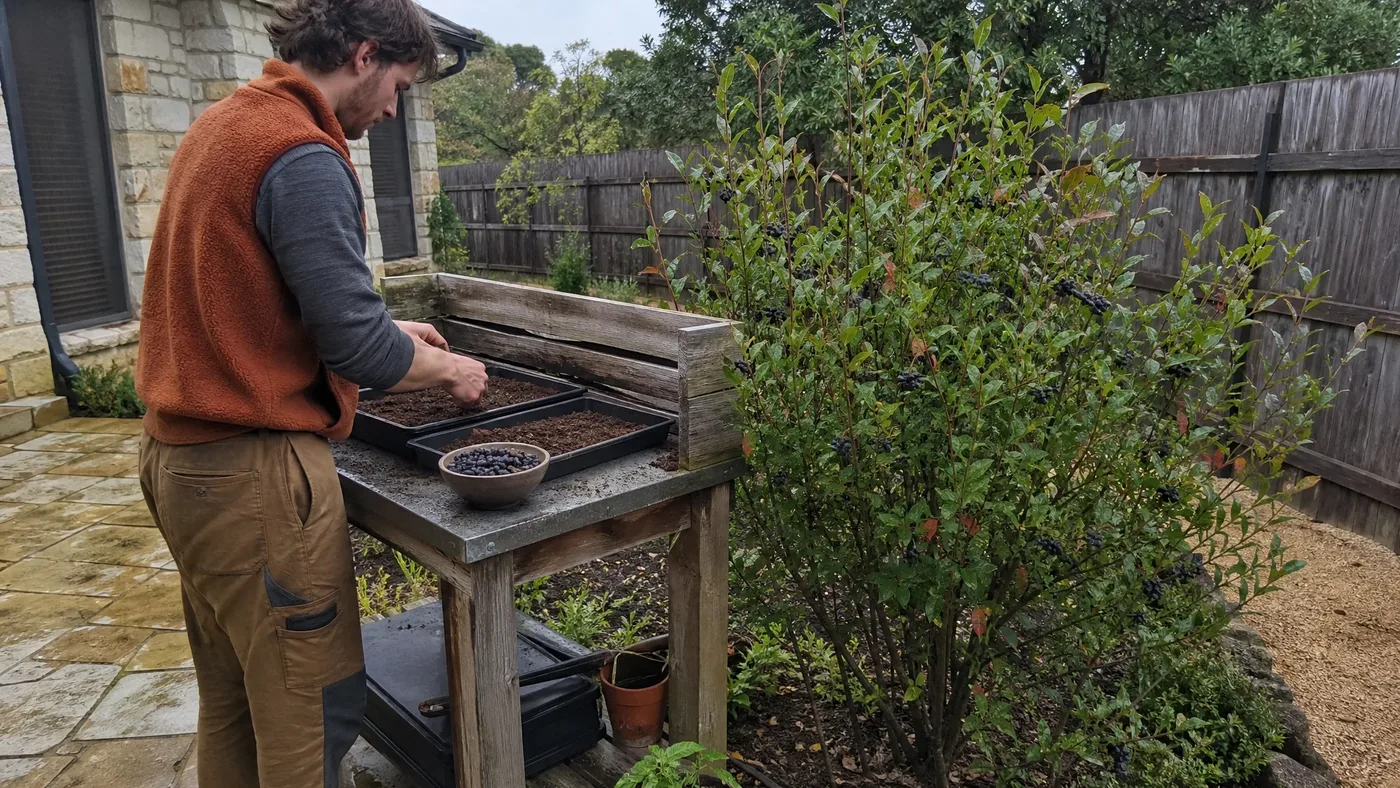
Fill shallow trays or small pots with a fine, moist seed-starting mix and press it level. The mix should be damp enough to hold together in your fist but never wet. Chokeberry seed is small, so take the seed out of its bag along with the damp medium and scatter it thinly across the surface, spacing the seeds so none touch.
Cover them with about 3/8 inch of mix, the sowing depth long recommended for chokeberry, and firm it gently with your palm. Mist the surface rather than pouring water on it, which would wash the seed into clumps. Label the tray with the date and the number of days the seed was chilled.
Slip the tray into a clear bag or under a loose lid to hold humidity, then set it in a bright spot out of hot direct sun. A windowsill or a shelf under lights is fine. Open the cover a little each day so air moves, and take it off entirely once the first sprouts appear.
The First Weeks of Chokeberry Bush Seedlings
Now comes the part that tests patience most, because you are watching a tray that looks empty and waiting for a sign.
Well-chilled seed can move faster than people expect. In the germination tests the Forest Service summarizes, stratified seed began sprouting after about 8 days and was nearly finished within 20 to 30 days. Still, not every seed wakes on the same morning, and a tray that looks bare for a while is not a failed tray. Keep it going and keep it labeled. Resist the urge to dig around, since you will only break the first fragile roots.
What Emerges
The first things up are a pair of small, rounded seed leaves on thin pale stems, pushed above the surface as the seedling rises.
True leaves follow, and they look like a tiny version of the leaf you know from the mature shrub. That is your sign that the seedling has settled in and can be treated as a plant rather than a hopeful seed.
Water and Light
Two habits decide whether this stage ends well: how you water and how much light you give.
Keep the mix evenly moist, never soggy. Water from below by setting the tray in a shallow pan until the surface darkens, or mist gently from above. A surface that stays wet and a lack of air are what cause young seedlings to collapse at the base. Give them as much bright light as you can. Seedlings that stretch and lean are asking for more, so move them closer to the window or lower the lights.
Thinning, Potting on, and Hardening Off
Once the seedlings crowd one another, they need room, then individual pots, then a gradual introduction to weather.
Thinning Crowded Seedlings
Thin when leaves begin to touch and the seedlings compete for light.
Snip the weakest at the soil line with small scissors instead of pulling, which tears the roots of the ones you keep. Leave the sturdiest seedlings spaced a little apart. It feels wasteful, but a crowded tray gives you many weak plants and a thinned one gives you a few good ones.
Potting On
Move each seedling into its own small pot when it has several sets of true leaves and a root system that holds together.
Use a free-draining potting mix and lift the seedling by a leaf, never by the stem. Red chokeberry grows in any soil texture including clay, wet or dry, so you do not need anything fancy. If you plan to keep young plants in pots for a while, our guide to growing chokeberry bush in containers covers the longer term.
Hardening Off
Seedlings raised indoors need to learn the outdoors gradually, or the first strong sun will scorch them.
Set them in open shade for a few hours, then lengthen the time and add morning sun over days, longer if nights stay cold. Bring them in if frost threatens. The mature shrub grows in full sun to part shade but flowers and fruits best in full sun, so work toward full sun by the time they are planted out.
A Chokeberry Bush Seedling Through Its First Year
The first year is mostly roots and leaves, and the table below shows what the seedling is doing and what you should do about it.
| Stage | What you will see | What to do |
|---|---|---|
| Spring, indoors | Seed leaves, then true leaves | Light, even moisture, thin if crowded |
| Late spring | Sturdy young plants in pots | Pot on, then harden off |
| Summer | Steady leafy growth | Water in dry spells, keep weeds back |
| Autumn | Leaves turning orange to red, color varying plant to plant | Note the best performers |
| Winter | Bare stems, dormant | Protect pots, otherwise leave alone |
Planting Out
When the young plants are well hardened, they can go to their permanent place in the garden, though plenty of growers keep seedlings in pots or a nursery bed until their second year.
Our guide to planting a chokeberry bush covers site, timing and steps, and it applies just as well to a seedling you raised yourself. Water through the first season, because young roots dry out faster than established ones.
The First Winter and What to Leave Alone
Red chokeberry is hardy in zones 3 to 9, so a planted seedling usually handles winter well. The exposed pot is the risk, because roots in a container freeze harder than roots in the ground. Mulch around planted seedlings and shelter potted ones.
Then leave them alone. Do not prune, do not push growth with heavy feeding, and do not dig one up to check its roots. Autumn color will vary from plant to plant, and that is your first look at what each seedling will be.
Your Established Chokeberry Bush Takes Shape
Looking ahead, the reward for all this waiting arrives over several seasons, and it arrives in a form that is yours alone.
Flowers and Fruit
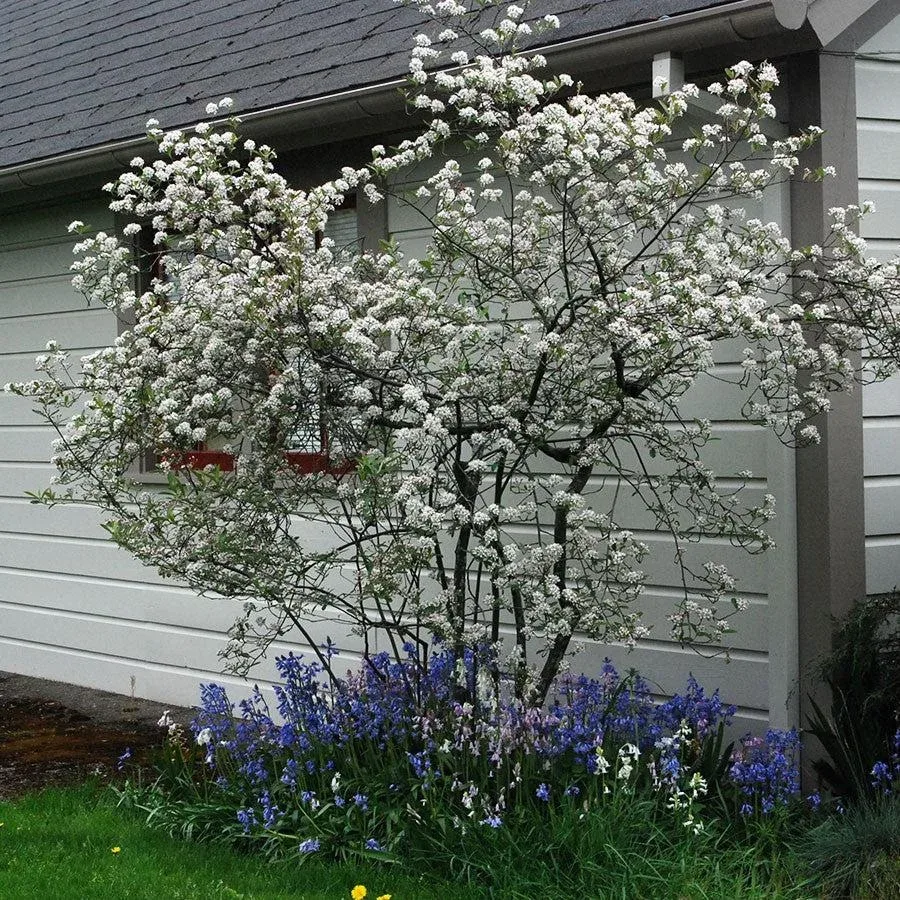
Expect clusters of white to light pink flowers with red anthers in May, as NC State Extension describes them. Our guide to chokeberry bloom time explains how that shifts with your climate.
The fruit follows as glossy red pomes about 1/4 to 1/3 inch across, ripening from September to November and often hanging on through winter. They are edible but so astringent raw that most people cook them into jams and jellies. Red chokeberry can fruit as early as 2 years of age, though a slow seedling may take longer, so give yours time before you judge it.
How It Differs From a Divided Plant
A divided plant is a copy of its parent, while a seedling is a new individual with its own habits.
Its height, fruit load and fall color may differ from 'Brilliantissima', which Oregon State's landscape plant guide singles out for excellent scarlet fall color and more abundant glossy red fruit. Red chokeberry in general grows slowly to 6 to 12 feet tall and 3 to 6 feet wide, so leave room. It also suckers, so your best seedling can become the parent of divisions later, which brings the story full circle.
Waiting on Your First Chokeberry Bush Berries
Seed asks for patience at every step: months of cold in a refrigerator, days or weeks of watching for a sprout, a year of leaves and then more years before a single flower. Each wait is small, and together they add up to a plant you have known since it was a seed. Some autumn years from now, you will walk out to a shrub in scarlet leaf and find the first glossy red berries hanging in their clusters, and you will know exactly where they came from.
Chokeberry Bush
Nursery-grown Chokeberry Bush in sizes from 2 GALLON, shipped to your door.
From $93.12
Shop Now →That is the slow route, and we respect anyone who takes it. Our growers watch the same 'Brilliantissima' shrubs through the year, for flowers in May, berries in fall and color after, and we grow and ship those shrubs ourselves.